Friday, 6 March 2026

The Broken Three-Legged Stool of Arminianism

The Broken Promises of Free Trade - Chronicles 

To my mind, if Arminianism were to have any theological credibility, that credibility depends on three legs or strands of thought. These are the following:

If any one of these three legs is broken, the Arminian stool is unstable. In my opinion all three legs fail biblically and theologically. 

For any readers unsure of what some of these key terms mean, I have linked to definitions on their first occurence in this piece.

Now, let's look at why each leg of the three-legged stool fails biblically and theologically.

The Myth of Prevenient Grace

The first leg of the stool is that there is such a thing as prevenient grace in the Arminian sense. This is very necessary for Arminians because all evangelical Christians must acknowledge that fallen human beings are unable to come to faith in Christ without divine help. Such are the effects of sin on us. Indeed reputable Arminians, just like Calvinists, acknowledge the truth of total depravity—that every part of us, mind, body, emotions, thoughts and will, are all corrupted by sin.

 Many verses allude to the truth of human inability. Here are a few:

  • "None is righteous, no, not one; no one understands; no one seeks for God. All have turned aside; together they have become worthless; no one does good, not even one." (Romans 3:10-12)
  • "For the mind that is set on the flesh is hostile to God, for it does not submit to God's law; indeed, it cannot. Those who are in the flesh cannot please God." (Romans 8:7-8)
  • "And you were dead in the trespasses and sins in which you once walked, following the course of this world, following the prince of the power of the air, the spirit that is now at work in the sons of disobedience—among whom we all once lived in the passions of our flesh, carrying out the desires of the body and the mind, and were by nature children of wrath, like the rest of mankind." (Ephesians 2:1-3)
  • "The heart is deceitful above all things, and desperately sick; who can understand it?" (Jeremiah 17:9)
  • "No one can come to me unless the Father who sent me draws him." (John 6:44a)
  • "The Lord saw that the wickedness of man was great in the earth, and that every intention of the thoughts of his heart was only evil continually." (Genesis 6:5)
  • "The intention of man's heart is evil from his youth" (Genesis 8:21)   
  • "The natural person does not accept the things of the Spirit of God, for they are folly to him, and he is not able to understand them because they are spiritually discerned." (1 Corinthians 2:14)
  • "No one can say “Jesus is Lord” except in the Holy Spirit." (1 Corinthians 12:3) 

Given this, how do we explain those who do come to saving faith and are seeking God and desiring to do good? The Calvinist has a simple answer—God's irresistible grace operating on the elect. In this sense the idea of prevenient or enabling grace is obviously true and necessary. God's grace must operate on the sinner before he or she can come to saving faith. The Calvinist acknowledges this obviously, but sees this as applying only to the elect, in whom such grace is always and irresistibly saving.

But the Arminian has a problem. How does the Arminian attempt to explain how anyone comes to faith given their view that what God wants and does for believers is the same as what he does for unbelievers? And there is no distinction as far as God's attitudes and actions go between how he acts on the elect and the non-elect (in Arminian terms between how he acts for those who believe and those who don't).

The Arminian answer is the concept of "prevenient grace"—a grace of God that applies to everyone, overcomes man's hostility and deadness in sin, and enables anyone to come to faith in Christ or reject Christ.

The question is where is a concept of a grace of God that overcomes sinfulness and enables everyone to believe or not as they will?

The biblical evidence for such a massively important doctrine for the whole Arminian system is scant at best. Simply put, there are no verses that clearly teach such a doctrine as Arminian prevenient grace. There are no verses that combined clearly teach it either. At best—I repeat, at best—there are a handful of verses that might, if read in a certain way, perhaps point to something like prevenient grace, but in no case do those verse have to be read that way and I would argue are better read in other ways.

Let's look at those verses now.

Some Arminians cite John 6:44, which we've already looked at: ""No one can come to me unless the Father who sent me draws him." (John 6:44a).

This verse cannot mean what Arminian prevenient grace needs it to mean, for the whole verse reads: "No one can come to me unless the Father who sent me draws him. And I will raise him up on the last day."

The grace operating here to enable a sinner to come is saving and effectual. All to whom it applies are raised up on the last day (clearly in context raised to salvation) and so this grace does not apply to those who reject it.

Other verses:

"For the grace of God has appeared, bringing salvation for all people" (Titus 2:11)

In context this clearly means "all kinds of people" and not everyone without exception who ever lived. If it meant that, the verse teaches universalism in salvation and not just prevenient grace. The whole passage in Titus 2:1-11 talks about various different groups of people and this is a much more natural reading of verse 11.

"The true light, which enlightens everyone, was coming into the world." (John 1:9)

Although possibly the strongest support that can be drummed up for prevenient grace, this verse does not mention grace at all. The Arminian interpretation requires the words "which enlightens everyone" to be considerably expanded to mean "a would-be saving grace that undoes total depravity and enables everyone to respond positively to the gospel".

What the verse actually refers to is "enlightening" or bringing light to everyone. This can equally well simply mean bring the light of truth and the light of judgment to humanity's dark deeds of sin. Given the context and the following verses about Christ being rejected as opposed to accepted because of this enlightening, it seems a massive stretch to draw the whole Arminian doctrine of prevenient grace from this verse.

"And I, when I am lifted up from the earth, will draw all people to myself." (John 12:32).

Another verse Arminians latch onto as supposedly teaching their concept of prevenient grace. I would suggest that "all people" or "all men" here is not referring to everyone without exception, but everyone without distinction as is common in John's writings. Here Jesus is saying that while in his earthly ministry his mission was within the Jewish nation, after his death and resurrection, his mission will expand to include every nation—"all people".

Obviously the Calvinist vs Arminian debate has been raging for nearly 400 years and this post is not going to resolve it. But in my view, the first leg of the Arminian stool rests on very little biblical evidence and I consider it broken because the Bible does not teach prevenient grace in the Arminian sense anywhere.

The Myth of Libertarian Free Will

The second leg that Arminianism depends on is libertarian free will.

A reasonable definition of libertarian free will is the human being's power to choose between more than one possibility in any situation in which such freedom pertains. It means that where libertarian free will exists, and a choice is before a person, all the antecedent factors are insufficient to determine the choice that will be made. In other words, when a person is faced with the choice to do A or not to do A (A can be any action), everything in that person—his character, his desires, his needs, his history, his genetics, his past and current environments, none of that is sufficient to account for whether the person will choose A or not-A.

This is in contrast with what is called compatibilist free will in Reformed theology. According to compatibilist free will, we are free if our choice is (a) what we want to do, (b) not forced or coerced by anything external to us, and (c) could have been otherwise if we had wanted to do otherwise. However, note that compatibilist free will acknowledges that our will (which Jonathan Edwards defined as "the mind choosing") is according to our strongest desire in any given situation. Most importantly, compatibilist free will recognises that many factors, such as character, needs, history, environment, genetics, and so forth, form a matrix according to which our strongest desire in any situation can be arrived at by a combination of all these factors.

To put it more simply, according to compatibilist free will, our free choices are compatible with God's decree because he is able to control the many factors that lead to what our strongest desire will be in any situation and upon the basis of which we will make our choices. But libertarian free will denies this. 

Essentially, since no prior factor or combination of factors can lead to a person having a desire that determines their free choice, libertarian free will ends up being unable to explain why a person chooses option A over option B at all. In fact, libertarian free will requires that exactly the same facts and factors that led a person to choose option A could just as easily have preceded the person choosing option B. The choice ultimately ends up being not because of anything, but because the person chose it, with no decisive explanatory reason. Otherwise, according to libertarians, the choice was not free. This in itself is problematic.

More significantly though, from a theological and biblical point of view, if we have libertarian free will, not even God can determine what our choices will be. Once he gives the gift of libertarian freedom, he simply has to accept what we choose. He can warn, threaten, persuade, woo, entice, and so forth, but he cannot make us do anything he decrees us to do, at least not if the choice is to be regarded as a free choice, or a choice made according to our free will.

The question we must ask is whether this is how the Bible speaks of human choices or not? Certainly, the Bible is full of  people being given choices and making choices. That much can scarcely be disputed:

  • Perhaps most significantly for humanity, Adam and Eve in the Garden were given the choice of obedience or disobedience in eating from the tree of knowledge of good and evil (Genesis 2-3) and chose disobedience.
  • "I call heaven and earth to witness against you today, that I have set before you life and death, blessing and curse. Therefore choose life, that you and your offspring may live, loving the Lord your God, obeying his voice and holding fast to him, for he is your life and length of days, that you may dwell in the land that the Lord swore to your fathers, to Abraham, to Isaac, and to Jacob, to give them." (Deuteronomy 30:19-20)
  • "Now therefore fear the Lord and serve him in sincerity and in faithfulness. Put away the gods that your fathers served beyond the River and in Egypt, and serve the Lord. And if it is evil in your eyes to serve the Lord, choose this day whom you will serve, whether the gods your fathers served in the region beyond the River, or the gods of the Amorites in whose land you dwell. But as for me and my house, we will serve the Lord." (Joshua 24:14-15)
  • " No temptation has overtaken you that is not common to man. God is faithful, and he will not let you be tempted beyond your ability, but with the temptation he will also provide the way of escape, that you may be able to endure it." (1 Corinthians 10:13)

The problem is that whenever the Bible mentions choices or decisions or options, the Arminians sees this as proving libertarian free will, but it does no such thing. All it shows is that people make choices, real choices. In no way do any of these passages mean that the choices cannot be determined by prior factors as in compatibilist free will.

More important for libertarian free will is the fact that on a number of occasions the Bible is clear that people's free choices (free in the compatibilist sense of doing what we want to do) can be determined by God as to how the choices should go. This is perfectly in line with compatibilist free will but devastating to the concept of libertarian free will. 

Consider the following verses, each easily explained on compatibilist free will principles and impossible from a libertarian free will standpoint (except perhaps in Molinism where God uses foreknowledge to control libertarian free choices). The problems with Molinism I have addressed before here and here. Our present discussion concerns Arminianism as a whole.

"As for you, you meant evil against me, but God meant it for good, to bring it about that many people should be kept alive, as they are today." (Genesis 50:20)

Here it is clear that though Joseph's brothers had evil intent towards him in selling him into slavery—and that choice was obviously freely made by them—nevertheless, they were carrying out the very purpose and intention of God which would ultimately lead to Joseph coming to power in Egypt and even saving the very brothers who had acted against him.

"And I will give this people favour in the sight of the Egyptians; and when you go, you shall not go empty, but each woman shall ask of her neighbour, and any woman who lives in her house, for silver and gold jewellery, and for clothing. You shall put them on your sons and on your daughters. So you shall plunder the Egyptians." (Exodus 3:21-22)

Another passage that points strongly towards comptaibilist free will. It seems clear enough that the Egyptian women gave gifts to the Israelite woman freely. But it could not have been libertarian free will because God says that he "will give this people favour in the sight of the Egyptians." He is able to ensure the Egyptians will have a favourable attitude, yet act freely. This is precisely what compatibilist free will allows for, but libertarian free will could not guarantee.

"But Sihon the king of Heshbon would not let us pass by him, for the Lord your God hardened his spirit and made his heart obstinate, that he might give him into your hand, as he is this day." (Deuteronomy 2:30)

Here instead of making someone willing to do something, God makes someone's heart obstinate. Yet Sihon was in no sense coerced. He did what he wanted to do, which was at the same time, what God wanted him to do. 

"And they kept the Feast of Unleavened Bread for seven days with joy, for the Lord had made them joyful and had turned the heart of the king of Assyria to them, so that he aided them in the work of the house of God, the God of Israel." (Ezra 6:22)

In this verse, not only does it say the Lord made his people joyful, but that he was able to "turn the heart of the king of Assyria". This is not something God is supposed to be able to do according to libertarian free will. 

"A man’s heart plans his way, But the Lord directs his steps." (Proverbs 16:9, NKJV).

"The king's heart is a stream of water in the hand of the Lord; he turns it wherever he will." (Proverbs 21:1)

These two verses from Proverbs both indicate God ability to direct and turn our plans and decisions to what he wants us to do, even in the case of the king—the most powerful man in a nation in the ancient world.

"This Jesus, delivered up according to the definite plan and foreknowledge of God, you crucified and killed by the hands of lawless men." (Acts 2:23) 

"For truly in this city there were gathered together against your holy servant Jesus, whom you anointed, both Herod and Pontius Pilate, along with the Gentiles and the peoples of Israel, to do whatever your hand and your plan had predestined to take place." (Acts 4:27-28) 

Finally, we look at these two verses in Acts concerning the crucifixion of Jesus. Both verses make the point that the crucifixion took place according to God's plan and purpose, yet those human agents involved in it—the Jewish authorities, the Romans, Pilate and Herod—all acted to do what they wanted and are responsible for their wicked and lawless deeds. 

The point is made. Scripture clearly teaches that human beings act freely when they do what they want to do, and yet God is able to control human desires in order to achieve his own purposes. 

The fact is that God operates at a higher level than anything within the created order. He is able to exercise his sovereignty not just to influence but to determine human choices and actions that, nevertheless, remain free. Given this, the concept of libertarian free will, in which human beings act autonomously, outside of divine control must be adjudged unbiblical. Accordingly, the bedrock doctrine of Arminianism, that human beings have libertarian free will is likewise unbiblical and so two legs of the Arminian stool are either broken or mere human fancies.

The Myth That God's Gives Up Sovereignty to Human Choices

The third leg that Arminianism requires is this idea that though it is acknowledged that God is sovereign, apparently he has sovereignly decided to give up being sovereign over certain things and placed them under the control of human free will.

This is one of the cleverest and most necessary moves that Arminian theologian have to make. The biblical evidence for God's sovereignty and ability to do whatever he desires and pleases to do is overwhelming.

A. W. Tozer famously wrote in The Knowledge of the Holy

God sovereignly decreed that man should be free to exercise moral choice, and man from the beginning has fulfilled that decree by making his choice between good and evil. When he chooses to do evil, he does not thereby countervail the sovereign will of God but fulfills it, inasmuch as the eternal decree decided not which choice the man should make but that he should be free to make it. If in His absolute freedom God has willed to give man limited freedom, who is there to stay His hand or say, 'What doest thou?' Man’s will is free because God is sovereign. A God less than sovereign could not bestow moral freedom upon His creatures. He would be afraid to do so. 

Although this is a clever argument, there is a huge problem with it. Despite how it sounds, this is actually a denial of God's sovereignty as understood by the biblical authors. Can you really imagine Isaiah or Paul accepting that God can somehow give up the very sovereignty that makes him the God of the Bible?

"For I am God, and there is no other; I am God, and there is none like me, declaring the end from the beginning and from ancient times things not yet done, saying, ‘My counsel shall stand, and I will accomplish all my purpose." (Isaiah 46:9-10)

"For from him and through him and to him are all things. To him be glory for ever. Amen." (Romans 11:36) 

No, this is a desperation move by the Arminians and it fails for lack of biblical evidence.  The Bible nowhere states that God uses his sovereignty in this way, to effectively give up his own sovereignty to the creature.

Given what the Bible does clearly state about how human free choices and human responsibility are compatible with God's sovereign control over all things, this last leg of the Arminian stool simply cannot bear the weight that would need to be placed on it. After all, God "works all things according to the counsel of his will" (Ephesians 1:11), including the free choices of human beings, for which we will ultimately be held responsible.

The Arminian stool is thus left without any legs and I would argue therefore must be rejected by anyone seeking to be guided by Scripture alone and in total (sola scriptura and tota scriptura) and not by human tradition or philosophy. 

Tuesday, 10 February 2026

21 Misunderstandings of Calvinism by Sam Waldron

This is an excellent resource that in short, sharp focus manages to destroy 21 common misunderstandings regarding Reformed theology.  

21 Misunderstandings of Calvinism | Sam Waldron

Warmly recommended. 

Thursday, 5 February 2026

Why Are So Many Churches Closing?

Scotland in 2026 is a country where many church congregations are being linked together and others are entering into unions, to form one new congregation. This is the case in my own denomination, the Church of Scotland, and may be true in other denominations as well. Because of this, a number of church buildings are now surplus to requirements and are being closed and where viable, sold off.

You know it has reached a significant point when stories about this are even appearing with regularity in the secular media. The usual story is a small group of "campaigners" railing against "the Church" for closing down their beloved building. Cue many irrate comment from others about how this is a "disgrace"—almost all of whom have never attended the congregation in question and may never have attended any place of worship for years.

What are we to make of all this? Why are so many churches being closed down?

At a human level, the answer is very straightforward. There are (or were) many more church buildings than could be sustained by the congregations who occupied them. Outsiders may think that the central church has massive amounts of money so that they can subsidise church congregations with so few members that they cannot afford to keep a building running and in repair on their own. In a sense this is true, and one of the strengths of the Presbyterian system of church governance. We are all one church and richer congregations do heavily and generously subsidise poorer congregations. However, even in this system, a point can be reached where there are simply too many separate congregations with their own buildings. The truth is we have now reached that point.

The membership of the Church of Scotland nationally has been in decline for many many years. At its peak in the 1950s, the Kirk had over a million members, roughly one in four of the population. By 1982, the Kirk had over 900,000 members, roughly one in six of the Scottish population. Today, the membership is around 280,000—about one in twenty of the population. That decline in membership has in no way been matched by a rationalisation of the Church's buildings, not to the same extent anyway.

The cost of maintaining buildings, many of which were built over a century ago or longer, is very high for a declining membership to bear.

This is the human explanation. But behind it is an even more important one—the theological or biblical explanation.

Why is God allowing this? 

Well, the truth is made plain in the Letters to the Seven churches in Revelation chapters 2 and 3. Christ promises that the gates of hell will not prevail against his church, but he does not give an unconditional pass to all congregations. Where congregations abandon God, fail to believe the biblical gospel, disobey the clear teachings on God's word, God is under no obligation to bless those churches. That he has permitted so many to survive this long is a testimony to the divine forbearance and sheer grace. Maybe today is a time of reckoning for the Church?

Some, no doubt, will advocate going further down the wrong path, to "keep the church relevant" and "to attract more people". The truth is that many churches in Scotland are healthy and growing, but I can assure you they are not the ones who have gone down the path of theological liberalism and ethical compromise with the world. That route we have been on for most of the last 100 years and it is a slow death march to oblivion. Nowhere are we commanded to be relevant in the New Testament. We are commanded to be obedient.

What the Church of Scotland needs most is a rediscovery of the truths of the Bible and a return to the message of the gospel. Thankfully there have always been and continue to be some congregations, many individual members and plenty of ministers who still hold to the old truths. My prayer is that God will continue to honour those who honour him and continue his work to reform the Church of Scotland according to the Word of God in 2026 and onwards as he did in centuries past.

Wednesday, 4 February 2026

Great Theologians 6: John Owen


John Owen (1616-1683)

John Owen is one of the most important theologians in the Reformed tradition of all time, and may justly be considered the leading theologian of the Puritan period in England. For good reason, he is often referred to as the Prince of the Puritans.

His life encompasses a huge range of achievements as a nonconformist church leader, theologian, academic, chaplain and even, briefly, a Member of Parliament.

He was of Welsh ancestry but born in Stadhampton, Oxfordshire in 1616 (his actual birth date is unknown). He graduated from Oxford University with a BA in 1632 (aged 15 or 16!) and an MA in 1635.  

He was brought up and followed the Puritan tradition and upon the outbreak of the English Civil War, he sided with the Parliamentary forces against King Charles I. This decision would cost him as he was cut off from inheriting his Welsh uncle's fortune, who was an ardent royalist.

He eventually became a chaplain to Oliver Cromwell and preached a sermon before Parliament the day after King Charles was executed in 1649. He was later appointed as Vice-Chancellor of Oxford University by Cromwell in 1652.

A congregationalist in church polity, Owen took a leading part in the Savoy Declaration of 1658, which was a revision of the Westminster Confession of Faith, the main revisions being the sections on the Church and Church governance.

Owen married his wife in 1644 (Mary Rooke) and the couple had 11 children, but 10 of them died in infancy, as was not uncommon in those times.

Owen's legacy to the church is an enormous body of writings. He was, by any standard, a prolific writer. However, unlike other Puritan writers like Thomas Watson, Owen was not blessed with an easy or attractive prose style and many of his works are a challenging read for the modern Christian. That said, his volumous output contains many classic works of the Reformed and Puritan tradition. His collected works run to 16 volumes. He also penned a monumental commentary on the Letter to the Hebrews, which runs to a further seven thick volumes.

Of the individual works which comprise his collected output, many are worthy of careful and repeated reading. His early work, A Display of Arminianism, written when Owen was 26, is a defence of Calvinist monergism and a refutation of Arminian synergism. One of his greatest and most enduring works is The Death of Death in the Death of Christ (1648) which is a full and polemical defence of limited atonement. In the words of J. I. Packer in his introduction to tbe Banner of Truth edition, Owen's work has never been refuted. Other works in Owen's output include an excellent treatises on the doctrine of justification and the work of the Holy Spirit.

Far from being a cold academic theologian, many of Owen's better known works are known for their practical application and warmth. These include Communion with GodThe Glory of Christ, and perhaps Owen's most practical book of all, The Mortification of Sin.

Owen continued writing in his later life. He died in 1683 aged 66 or 67 and is buried in Bunhill Fields cemetery in London.

Sunday, 1 February 2026

Chosen in Christ (Book Review)


Chosen in Christ: Revisiting the Contours of Predestination by Cornelis Venema (Reformed Exegetical Doctrinal Series, Christian Focus, Fearn, Ross-shire, 2019) 

It's been a while since I've done a book review on blog, despite having read a number of excellent Christian books in the last year. So, I thought it was high time to do one and the book I have just finished, is well worth reviewing and recommending.

The difficult doctrine of predestination or election has long been of particular interest to me and Cornelis Venema's book on the subject is an excellent contribution to this area of doctrine, often regarded as being at the heart of Reformed theology. As might be expected, Venema takes a Calvinist point of view and endorses unconditional election. This is reflected both in his positive presentations of his view and in his critiques of other approaches to election and predestination.

The book reads like a collection of essays on topics concerning predestination rather than a single cohesive treatise or argument on the subject. 

The first part of the book takes a biblical theological tour of the Bible's teaching on election and predestination across three chapters that look at, in turn, the doctrine of election in the Old Testament, the doctrine of election in the New Testament (excluding Paul) and then the doctrine of election in Paul's epistles. This material takes up about a third of the book.

The remaining chapters take a more historical theology perspective, with chapters on election and predestination in Augustine, Reformation theology, Arminian conditional election, Karl Barth's doctrine of election, and what Venema calls "Neo-Arminianism" - more commonly called Open Theism. As expected, Venema's treatment of Augustine and Reformed theology is positive, while his assessment of Arminianism, Barthianism and Open Theism are negative critiques.

The final chapter is entitled Concluding Theological and Pastoral Reflections where the author presents his own reflections on some common objections to the Reformed doctrine of predestination, such as regarding evangelism and the gospel offer.

Election and predestination are scarcely the simplest of Christian doctrines and any treatment of them is bound to be somewhat complex. Venema's book is no exception. In my view, this is at least a semi-technical treatment, aimed at theology students and pastors more than a general Christian readership, I think many people would find it difficult to work through this book. It offers an in depth treatment, particularly of the various deviations from the Reformed doctrine. I would not recommend it as a first read on this topic by any means. For that, I would suggest various other works, whether one of the many books on the Five Points of Calvinism, or A. W. Pink's The Sovereignty of God or James White's The Potter's Freedom. In addition, the relevant chapters of a good Reformed systematic theology, such as Berkhof, would be worth reading before turning to this book from Cornelis Venema. 

The work is valuable for a more in-depth study of the subject, particularly as I said, for the historical analysis and context.

Saturday, 3 January 2026

Why I Value the Byzantine Text of the New Testament

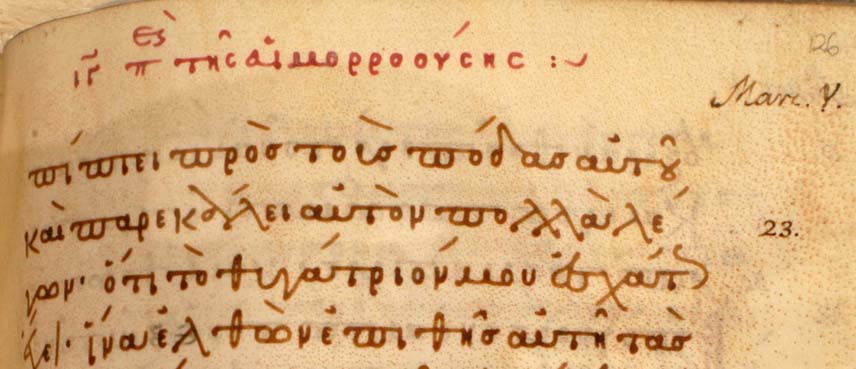
Excerpt from Gospel of Saint Mark showing Minuscule script with title rubricated 

I am certainly no expert on textual criticism, but I have been interested in the subject for many years. In a previous post, I outlined the case for reasoned eclecticism in New Testament textual criticism and I believe that approach is essentially valid. However, for a long time I'vne had some misgivings about the approach taken by current scholarship in how reasoned eclecticism treats the existing evidence.

New Testament textual criticism is a very complex and technical discipline. The fact is that there are around 5000 Greek manuscripts in existence at this time. They range from fragmentary scraps of papyrus with just a few verses through to a few containing all or almost all the New Testament. In age, they range from texts dating from the second century all the way through to some very late manuscripts dating from after the advent of the printing press. These Greek manuscripts are the most important witnesses to the original Greek readings. As no two handwritten manuscripts are exactly the same, the task of the critic is to assess what the most likely reading is in the original autographs (the documents the apostles originally wrote).

At the risk of oversimplifying matters, there are two broad approaches that are taken with the evidence. The vast majority of modern scholars favour what is called 'reasoned eclecticism.' There are a lot of principles and rules around this approach, but in practice, just as the scholarship has held since Westcott and Hort in the 19th century, the manuscripts are "weighted" rather than "counted" and so preference is given to the much smallers number of older manuscripts over the far greater number of later manuscripts. Time after time, when looking at places where there are textual variants, the modern critical Greek New Testaments (currently known as NA28 (Nestle-Aland 28th Edition) and UBS5 (United Bible Societies 5th Edition) go with the readings of three or four of what are deemed the most important manuscripts because they are older, against sometimes a thousand later manuscripts.

The second broad approach takes the opposite course, and gives greater weight to many later manuscripts against the very few earlier ones. Outside the Book of Revelation, which has its own particular textual issues, the split on textual variants is not even close. Most of the time fully 85-95% of the manuscripts point one way and 1-2% point the other way. This fact is probably at the heart of why I feel the original text is more likely, on some occasions at least, to be in the Byztantine text—the text supported by  85-95% of the evidence, though admittedly by later manuscripts, and not in the critical text with readings often supported by only handful (or even just one) of the oldest manuscripts.

The reasons for my valuing and in some cases preferring the Byzantine text is outlined as follows. Before going into that, we should make the point that the vast majority of the New Testament is the same whether we use the traditional Byzantine text or the critical editions that try to reconstruct the original text largely built on two manuscripts, known as Sinaiticus and Vaticanus along with some early supportive papyrii.

So here are my ten reasons:

1. The Text of the Vast Majority of the Manuscript Evidence

The first and most important reason for preferring the Byzantine or Majority Text over the critical text is that it is by far the text with the strongest support in the Greek manuscripts. The typical level of support in the manuscripts is 85-95% of the evidence being in its favour. By contrast, the critical text, in those places where there are meaningful textual variants, is often supported by less than 2% of the manuscripts and not infrequently by only one or two manuscripts. 

Absent some other intervening factor, the text that ended up in the vast majority of copies has an a priori claim to be most likely the original text.

This has been recognised at least implicitly by opponents of the Byzantine Text. For example, Westcott and Hort argued that the dominance of the Byzantine Text in the manuscript tradition and the comparative paucity of support for their favoured Alexandrian text had to be explained by there being an organised and deliberate recension of the text, making the most common Byzantine text and rejecting the Alexandrian text, which they believed was in fact closer to the original autographs. The problem is that there is no historical evidence that any such recension took place. Without it, there is no good reason to account for how the Byzantine text is so dominant in the manuscripts, unless it was the original text.

It is irksome that those who favour the critical text, which in many places, simply adopts the readings of two or three Alexandrian sources, especially Sinaiticus and Vaticanus and ignore thousands of Byzantine manuscripts, nevertheless trade on the fact that "we have 5000 manuscripts" of the New Testament when, in fact, they only really value a handful of early manuscripts where there are textual variants of note.

2. The Text Providentially Preserved by God 

We have not even begun to discuss the doctrine of "providential preservation" which is taught in the Reformed confessions. The Westminster Confession of Faith chapter 1.8 reads:

The Old Testament in Hebrew, (which was the native language of the people of God of old,) and the New Testament in Greek, (which, at the time of the writing of it was most generally known to the nations,) being immediately inspired by God, and by his singular care and providence kept pure in all ages, are therefore authentical;   so as in all controversies of religion, the Church is finally to appeal unto them. 

There are a couple of points worth noting here. The first and most important point is that for the Westminster divines, the inspired text of the New Testament was not a theoretical autograph that we are always aiming at, but never arriving at. When they talk about "the New Testament in Greek" they meant the Greek text they held in their hands and read. It was the actual text that existed at that time that they believed was "immediately inspired by God, and by his singular care and providence kept pure in all ages."

Now, while the textus receptus that underpinned the Geneva Bible, the King James Version and all the Protestant translations of the New Testament was the printed text of that time, the Byzantine Text found in the majority of manuscripts is only slightly different from this text, correcting the relatively few places where the TR does not have good Greek manuscript support.

However, this is quite different from the eclecticism of the critical texts, which require that far from the true text of the New Testament being "kept pure in all ages" this view requires that the true text was lost for almost 1500 years between the 4th century and the mid 19th century.

3. The Text with a wide geographical spread

The second arguement for the Byzantine text being the better text is that not only has it come down to us in the vast majority of manuscripts, but it also represents a wide geographical spread, being found in separate lines of transmission all over the Roman Empire, whereas the Alexandrian text in its older manuscripts has survived only in the area of Egypt, both in the great uncial manuscripts and the surviving papyrii.

Evidence from a wide geographical area is a second point in its favour. We may well ask why a text would be found over a wider geographical area as well as in most manuscripts reach that position unless it was copied many times and in many places by Christians who believed it to represent the true text of the New Testament. 

4. The Text that was actually in use by the Greek-speaking Church and Its Liturgy

Unlike the critical text which substantially relies on two obscure manuscripts, one rescued from destruction in a monastery in Egypt and the other kept in the Vatican library, the Byzantine text has been in use in the Greek-speaking church for over a thousand years. It is the text that has been influencing the life of the church all through the New Testament era. It is also the text that has been in use in the Protestant churches since the Reformation onwards.

5. The Text that has an internal consistency across sometimes hundreds of independent manuscripts 

The Byzantine text displays an extraordinary level of consistency and agreement across hundreds of manuscripts. While no two manuscripts are ever identical, each with its own scribal errors, nonetheless the Byzantine text is consistent. This is in sharp contrast with the two main Alexandrian uncials which hardly agree with one another in a single verse.

6. The Text that Fits the Fact that Scribes Tend to Omit Material More Often Than They Include Extra Material

One of the rules of modern textual criticism is that, all else being equal, the shorter text is to be preferred as more likely the original. However, many people are now questioning this. There is evidence that, in fact, scribes were more likely to omit material when copying rather than adding text. Such omissions would mostly be by accident, though perhaps sometimes deliberate.

The Byzantine readings are generally longer than the Alexandrian text. It seems quite arbitrary that assume the shorter reading is more likely original. In fact, I believe that the preference for the older manuscripts is the overarching reason that they are preferred. There are places where the longer reading is in the critical text. Here the critical text still goes with the older MSS.

The truth is that when handling what they believed was the Word of God, scribes were less likely to add to the text, which requires a deliberate action, whereas leaving something out can easily happen by accident. On this basis, we might infer that the longer text is more likely to be the original. 

7. The Text That Requires Unproven Conjectures to Undermine It

As we have already mentioned, unless there is some overriding reason to hold otherwise, the text that dominates the manuscripts—the text that has been copied the most—is statistically the most likely to be the original. Even the opponents of the Byzantine text recognise as much. This is why there have been a number of theories as to why they believe the secondary Byzantine text came to dominate whereas what they believe was the original text was all but lost. 

The most common of these theories is that at some point there was an official church recension or editing of the New Testament text, standardising it in the distinctly Byzantine direction.

However, no evidence of any such recension has been found. Absent this, there is no good reason to suppose that the vast majority of manuscripts are not the best indicator of the original text.

8. The Huge Amount of Comparatively Late Manuscripts Must Have Been Copied from Earlier Manuscripts

My next point is simply that the vast majority of manuscripts, representing the Byzantine text, did not come out of nowhere. Every manuscript that exists came from other earlier manuscripts. That is how copies are made. Studies show that the existing Byzantine manuscripts come from many lines of transmission. In other words, these manuscripts are not obvious copies of each other. They come form earlier, now lost, ancestor manuscripts.

An additional supporting point is that when written Greek shifted from the more difficult to read uncials (all written in capital letters with minimal punctuation and sometimes no spacing between words) to the more easy to read minuscules (such as the image at the top of this post), when copies were made into the minuscule form, scribes would then tend to destroy the earlier uncial version. This would explain why there are no existing Byzantine uncials.

The existence of some Byzantine readings among the papyrii is also an indication that the Byztantine text goes back in time much further than the existing manucscripts indicate.  

9. The Lack of Early Manuscripts Points to the Text Being in Constant Use 

Closely aligned with the previous point, as well as being deliberately destroyed when new copies were made, the text that was in constant use in the early church would naturally wear out and need replacing. The only reason the likes of Sinaiticus and Vaticanus survived was because they were not in constant use. They were not texts that the churches used.

Logically, we would not expect early manuscripts to survive of the text was being read and used in churches all over the Greek-speaking Roman Empire.

In other words, the lack of early manuscripts in the Byzantine form, is actually an argument in favour of the Byzantine text being in use at earlier points in church history prior to the dates of the surviving manuscripts.  

10. The Text of the Reformation and the Reformed Creeds

Though our final point is not a textual one and definitely the weakest of the arguments put forward, I do not think it insignificant that the Byzantine text was the one which God in his providence used throughout the Protestant Reformation and right through to the 19th century.

The fact is that in God's church, the Byzantine text was not really replaced in the churches until the 1950s when the RSV came into use.

The Reformed creeds are based around the New Testament text found in the Textus Receptus, itself a form of the Byzantine text.

Conclusions

At present, there are no committee translations of the Byzantine text (or Majority text). The only translatons are of the Textus Receptus, which departs from the majority Byzantine readings on a number of occasions. The main options are the King James Version and the New King James Version. The latter is particularly useful because the New Testament footnotes show there the majority text and the critical text differ from the TR.

There are two excellent translations produced by Robert Adam Boyd, a Wycliffe translator. One is a revision of the American Standard Version (1901) in which Boyd has changed the New Testament to conform to the Byzantine Text. The other is a fresh translation of the Byzantine Text into modern English, which Boyd calls the Text-Critical English New Testament: Byzantine Text Version. This version reads similarly to the ESV or Christian Standard Bible in terms of the translation style.

It would be very useful if a Byzantine version of the ESV or NIV could be produced. Most of the key readings would be found in the footnotes of these versions anyway.

The World English Bible (WEB) which is another public domain translation, is also based on the Byzantine text. 

Saturday, 27 December 2025

Christmas 2025

 Wishing all our readers a happy and blessed Christmas season. 


Tuesday, 16 December 2025

Hell and the Fate of the Wicked

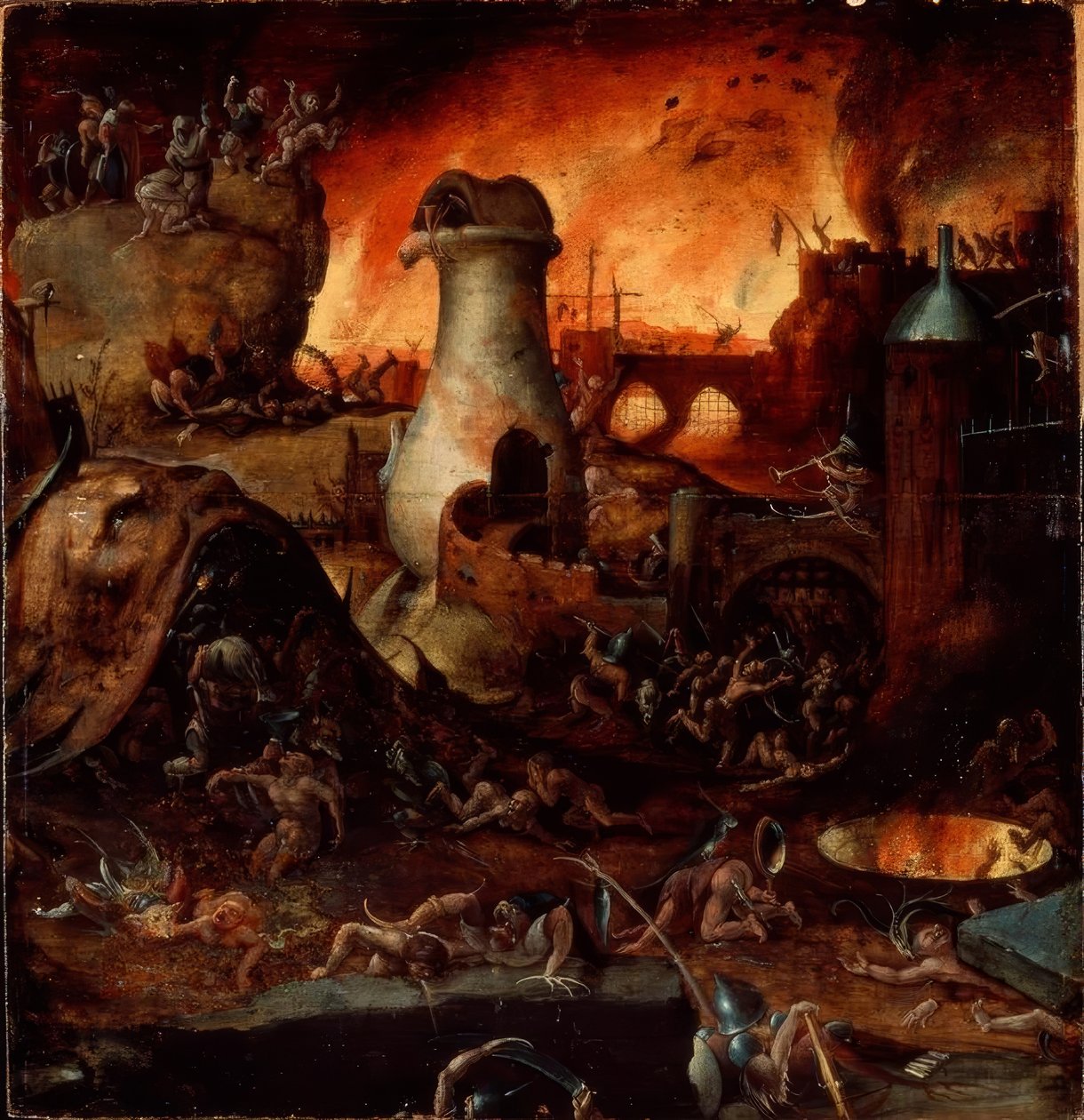
Hell by Hieronymus Bosch 

For many years, I have wrestled with hell. By that I mean the doctrine of the final state of the wicked.

There are a spectrum of views, of course, on this subject, but in my view it comes down to two main views among evangelicals. A third view, that ultimately everyone will be saved (known as "universalism") is not supported by more than a tiny minority of those claiming to be evangelical. That leaves two views among evangelicals.

First, there is what is known as the traditional view that the final state of the non-saved is eternal conscious torment and punishment in hell. This view is almost inconceivable for the human mind to comprehend. For a person to experience punishment and, in some sense, pain, for all eternity is an idea so horrific that I think few of us want to even contemplate it. The exact details are sketchy at best biblically - darkness, fire, pain, torment, certainly much less detailed than the vivid medieval depictions of the likes of Dante in writing and Bosch in art.

Nevertheless, it is the most common view held by Reformed and evangelical Christians and there are a number of strong biblical arguments in its favour. It is also the view taught in the Reformed confessions.

Several verses are difficult to reconcile with the idea that the punishment in hell is only temporary in duration.

Matthew 25:46 is one such verse where Jesus himself says: "These [the wicked] shall go away into eternal punishment, but the righteous into eternal life."

Notice he does not say "eternal death" in contrast to eternal life, but "eternal punishment". At least on the face of it, if eternal life is never ending, it would appear that eternal punishment may be never ending also.

A second verse of relevance is Revelation 14:10-11, speaking of those who worship "the beast": "He also will drink the wine of God's wrath, poured full strength into the cup of his anger, and he will be tormented with fire and sulphur in the presence of the holy angels and in the presence of the Lamb. And the smoke of their torment goes up for ever and ever, and they have no rest, day or night, these worshippers of the beast and its image, and whoever receives the mark of its name."

"The smoke of their torment goes up for ever and ever" does not sound like annihilation to me. 

A third relevant passage is Revelation 20:10 and 15. "The devil who deceived them was thrown into the lake of fire and sulfur, where the beast and the false prophet are also. They will be tormented day and night forever and ever.... If anyone was not found written in the book of life, he was cast into the lake of fire."

Again, on the face of it, it could be argued that since the lake of fire seems to inflict torment forever, and all the wicked are thrown in there, their suffering would be eternal.

The second view has several different names, but in essence it is that while there is punishment in hell for the wicked, at some point the conscious torment ends and the person in hell ceases to exist. This view is sometimes called "Conditional Immortality" or "Annihilationism". It is sometimes portrayed as if this view teaches that when the wicked die, they immediately cease to exist. There may be some who teach that, but the mainstream of this view is that the wicked are punished in hell for a period of time related to the punishment they deserve for their sins, but that this punishment does not continue forever, but eventually they cease to exist.

In the first view, if a sinner is tormented in hellfire for a million years, he is no nearer the end of his infinite punishment than when he first entered hell. In the second, if the just punishment is punishment for a million years, at the end of this time, the sinner ceases to exist and the active punishment ends, though the sentence of eternal death remains effective forever. 

Like many theological disputes, and perhaps more than most, there are good biblical arguments on both sides. Anyone who thinks that the opposite side in this discussion does not have good arguments, simply does not understand the best arguments of the other side.

It is unlikely we will ever be able to be certain about which view is correct this side of eternity. I admit that I cannot really conceive what eternal active punishment looks like. For that matter, I can hardly conceive what everlasting life looks like either. Part of me hopes that annihilationism is true. There may be people I love in hell after all. Eventual non-existence seems more attractive than eternal existence in suffering. As many have pointed out, how can the saints fully rejoice in heaven, knowing their loved ones are writhing forever in the pain of hell?

Yet we must not let our emotions guide our doctrine, but the teaching of the Word of God. And as we have seen, there are certainly verses that point in the direction of eternal conscious punishment. 

All I can say is: "Shall not the judge of all the earth do right?" (Genesis 18:25). Whatever God does with the wicked will be the right thing in the end and it will be marvellous in our eyes (Psalm 118:23) because the fate of the wicked whatever else it is, will be according to divine justice.

Wednesday, 10 December 2025

More Than One Reformed Approach to Many Texts

It's important to recognise that there is not only one way to interpret many texts in Reformed theology. There is a breadth within Reformed theology that leaves enough room for each person to have room to explore their own views while being on the inside of the circle of Reformed theology.

One important example of this that I've had in mind for some time are the Reformed approaches (plural) to the interpretation of a well-known verse such as John 3:16.

We need hardly quote what is surely the most famous verse in the whole Bible, but it reads of course, something like this:

"For God so loved the world, that he gave his only Son, that whoever believes in him should not perish but have eternal life" (John 3:16, ESV).

There are broadly two main Reformed approaches to this verse. My view, explored in some length in my book, The World of John 3:16 could be considered the more restrictive Calvinist view. I interpret the word "world" to mean "sinners from all nations" (i.e. Jews and Gentiles) and that it refers by extension to God's elect from the nations. One of the reasons for taking this view is that the love of God mentioned in this verse seems to me to be the highest type of love in God, his redeeming and electing love that achieves its aim of saving "the world" (see John 3:17). This is the view of many Calvinists—many older Calvinists it is probably fair to say, such as John Owen, Francis Turretin, Samuel Rutherford, John Gill and Arthur W. Pink.

However, I recognise that my interpretation may be incorrect and that there is a second broad interpretation which is every bit as Reformed. The other view interprets "world" as meaning "the human race" or "all of humanity". This view shares with our Arminian brothers and sisters the view that the world is all-inclusive, meaning every human being without exception. However, in this view, the love of God for the world is not the highest type of electing, saving love that God has for his people, but a more general benevolence encompassing everyone, and showing them that he is a God of compassion with what D. A. Carson calls "a salvific stance" towards everyone. 

This simply means that his revealed will shows that God has some kind of intent towards the salvation of everyone who hears the gospel on the condition that they would believe. This is the view of many modern Calvinists, but also people in history, arguably John Calvin himself, Thomas Boston and the Marrow Men, and contemporary Calvinists such as R. C. Sproul, John Piper, D. A. Carson, and John MacArthur as far as I can make out.

There are some good arguments for this wider view, though I am not personally convinced by them. That's not to say I deny that other parts of Scripture do indeed teach that God takes no pleasure in the death of the wicked and would have everyone who hears the gospel accept it and be saved in accordance with his revealed or preceptive will, though not in the sense of it being God's decree or we would need to be universalists. It's only that I do believe that John 3:16 is correctly viewed as a text of this type.

Similar arguments could be applied to a number of other texts about which Reformed Christians may take different views. These include what might be called the "Arminian" proof texts such as Matthew 23:37, 1 Timothy 2:4 and 4:10, 1 John 2:2, and 2 Peter 3:9. On all these some Calvinists interpret them in a more restrictive sense, others accept the wider sense, yet deny that they undermine the doctrines of grace taught in Calvinism.

The Reformed Faith is not a monolith. And I believe it is all the richer for it.


Monday, 1 December 2025

Advent 2025


Yesterday was the first Sunday of Advent. It marks the beginning of a new Christtian year and the start of the period of Advent leading up to Christmas.

Advent comes from the Latin "adventus" which means "coming" or "arrival". It refers to the period of waiting for the coming or arrival of Jesus Christ, both in terms of his first coming as a baby born in Bethlehem and his second coming in glory at the end of the world. A third sense, which we do not often focus on, is the coming of Christ to live in the hearts of believers through the Holy Spirit.

The long run up to Christmas, much longer in the world of modern commerce than in the church calendar, is one of my favourite seasons of the year.

The great advent hymn, "O come, O come, Emmanuel" can be sung with any of the three senses of the coming of Christ in mind.

I was very interested to learn recently that though the words and music of this great hymn are ancient, they were not joined together until the 19th century, when John Mason Neale translated a medieval Latin text into English in 1851 and then got his friend Thomas Helmore, who used a French medieval sacred tune and reharmonised it to work with Neale's words. For many years there was doubt as to whether had actually composed the tune and only claimed to have "discovered" it. However, in 1966 it was established that it was an ancient French tune. The tune is known as VENI EMMANUEL after the Latin text's opening words.

The resulting text and tune combine to make one of the greatest of advent carols. I could not imagine going through advent without singing this great hymn at least once.


Thursday, 27 November 2025

The Case for Reasoned Eclecticism (in New Testament Textual Criticism)

https://support.bl.uk/DynamicImages/8243638d-01fc-4f9e-ba3a-9e8d0170f293/Codex-Sinaiticus-ff244v-245--Open-at-St-Lukes-Gospel-chapter-22-20-71-chapter-23-1-13.JPG?width=1024
Codex Sinaiticus, 4th Century Greek Manuscript

Few topics stir as much debate among Christians, historians, and biblical scholars as the question of how we determine the original text of the New Testament. I am certainly no expert on textual criticism, but I have been interested in the subject for many years and here are where my thoughts on this subject have taken me so far.

Let's start with a few facts that are not in dispute. The books of the New Testament were originally penned by the apostles and the originals they produced are called the autographs. In God's wisdom, we no longer possess the original autographs—all have been lost in time, and so none can be venerated by Christians. We do not possess the autographs, but we do possess over 5,800 Greek manuscripts and thousands more in ancient translations, especially Latin. 

The sheer abundance is a blessing and vastly exceeds the manuscript evidence for any other work of antiquity. Yet this abundance of manuscripts also presents a challenge. Prior to the advent of the printing press in the Renaissance period, every copy of the New Testament had to be laboriously copied by hand. As a result, all manuscripts differ in places with every other manuscript in thousands of ways. Most of these are tiny and largely inconsequential such that they would not even show up in an English translation (spellings, word order, etc.). However, there are hundreds of places where the manuscripts' differences do affect the text—none are so significant that they seriously affect any doctrine—but they do result in potentially different readings within the New Testament. These are known as "textual variants". In modern bibles, you will find them on most pages of the New Testament, where the main text reads one way, but footnotes present alternative possibilities. 

The question is: How do we decide which reading is most likely the original?

There are a number of different schools of thought among scholars as to how best to answer this question. 

The most widely used and academically respected approach today is known as reasoned eclecticism. This method stands behind the standard critical editions that lie behind almost all mainstream English translations. These are called the Nestlé-Aland 28th Edition and the United Bible Societies 5th Edition (known as NA28 and UBS5).

While no method is perfect, reasoned eclecticism offers the most balanced and historically sensitive way to reconstruct the earliest recoverable and most likely original text.

Though not an essential part of reasoned eclecticism per se I think it is also worth stating that my personal view is that the text of the autographs, the actual words of the apostles that are God-breathed (2 Timothy 3:16), have not been lost, but are to be found in the manuscript evidence God has providentially preserved. The true reading is to be found either in the main printed text or the footnotes of our bibles.

The other thing I would want to add is that there are sometimes when I believe the academic consensus on what the most likely original reading is may be incorrect. Reasoned eclecticism leaves it open to each person to study the evidence, consider the arguments, and make up their own mind. Some may complain this leaves uncertainty as to the original text, but I would simply reply that it is the existence of textual variants in the text that creates this uncertainty. Reasoned eclecticism simply embraces the facts. Other approaches seem to want to trade truth for certainty and may end up with neither.

The following are the main reasons why I believe that reasoned eclecticism is the best approach to New Testament textual criticism.

1. Reasoned Eclecticism Uses ALL the Manuscript Evidence, Not Just Part of the Evidence

Some approaches prioritize the numerical majority of extant manuscripts (known as the Majority Text or Byzantine Priority Approach), and others almost exclusively privilege a single text type (as in some Alexandrian-priority arguments). Reasoned eclecticism avoids both extremes.

It considers:

  • External evidence: the age, geographical distribution, and textual relationships of manuscripts.
  • Internal evidence: what scribes tended to do, and what an author is likely to have written.

By drawing from the full spectrum of available data: papyri, uncials, minuscules, versions, and patristic citations. It avoids the tunnel vision that comes from using only one subset of the evidence.

Reasoned eclecticism makes the simple but essential claim: the original reading is more likely to survive in the oldest manuscripts, all other factors being equal. Thus the witness of a few oldest sources is at least if not more valuable that a large majority of later manuscripts. Fundamental to this approach is the recognition that manuscripts must be weighed and not just counted. Secondly, where the external evidence is not clear-cut, we must examine the internal evidence and a judgment is needed to assess which reading is (a) least likely a scribal error or addition and (b) is the variant that most likely explains the existence of the other variants.

2. Reasoned Eclecticism Recognises That Manuscript Numbers Alone Cannot Determine Originality 

Most New Testament manuscripts were copied in the Byzantine Empire after the 9th century. They are numerous not because they preserve the earliest form of the text, but because Byzantine copying was prolific and stable. A reading supported by a thousand manuscripts from AD 1000 may be historically inferior to a reading supported by two manuscripts from AD 200.

Reasoned eclecticism therefore avoids the fallacy that “more manuscripts = more original.” Instead, it asks: Which manuscripts stand closer to the earliest recoverable stages of transmission? Often, the early papyri from Egypt represent earlier streams of copying, even if they are fewer in number.

Quality, not quantity, is what matters then sifting the available evidence.

3. Reasoned Eclecticism Acknowledges Scribal Habits (Both Errors and Expansions)

Copyists made predictable mistakes. For example, they tended to:

  • Expand names and titles for clarity (“Jesus Christ” → “the Lord Jesus Christ”).
  • Simplify grammar or wording.
  • Harmonize parallel passages (both in the Gospels and in Paul's Letters).
  • Add explanations to difficult verses or soften verese thought to be too hard.
  • Add marginal notes into the body of the text for fear of leaving out anything important.

Reasoned eclecticism takes these tendencies seriously. A reading that is more awkward, shorter, or harder is often more likely to be original because scribes typically smoothed and expanded rather than created difficulties. No other method consistently accounts for this behaviour by those who copied the New Testament by hand.

4. Reasoned Eclecticism Takes Account of Authorial Style and Context

Not every variant is best explained by scribal habits alone. Sometimes one reading simply fits better with the vocabulary, theological themes, or narrative flow of the author.

For example, Johannine vocabulary is distinctive. If a variant reading uses terms foreign to John’s style, reasoned eclecticism recognises that it may be secondary. Likewise, if a variant disrupts the flow of argument, that too must be weighed.

Reasoned eclecticism gives us the freedom to integrate literary and contextual insights alongside manuscript evidence.

5. Reasoned Eclecticism Avoids Rigid Formulas and Instead Balances Probabilities

Some text-critical methods operate with simplistic rules, such as “prefer the shorter reading,” or “prefer the reading with majority support.” Reasoned eclecticism explicitly rejects such wooden approaches. Instead, it weighs evidence case by case, instance by instance, recognising that real historical transmission is complex.

This does mean scholars sometimes disagree. But disagreement is not a weakness—it’s a sign that the method is flexible, honest, and evidence-driven rather than ideology-driven.

Far from being a weakness, the fact that some conclusions have to be tentative and open to correction is a strength of the approach.

6. Reasoned Eclecticism Helps Explain Why Some Famous Passages are Disputed

Reasoned eclecticism is the method behind scholarly discussions of passages such as:

  • Mark 16:9–20 ("The Longer Ending of Mark")
  • John 7:53–8:11 ("The Pericope Adulterae"
  • The Ending of the Lord’s Prayer in Matthew 6
  • John 5:4 (The Pool of Bethsaida) 
  • Luke 2:14 
  • 1 Timothy 3:16
  • Romans 8:1 
  • 1 John 5:7-8 ("The Comma Johanneum") 

And many other passages. 

In each case, reasoned eclecticism weighs early manuscripts, later manuscripts, scribal habits, authorial style, and historical plausibility. Sometimes the result is that a well-known reading is judged secondary. That can be uncomfortable, but it is honest.

The methodology also allows scholars and readers to judge the evidence and make up their own mind. No one is forced to accept the majority opinion on any of these variants. 

A method that never challenges traditional readings is not a historical method; it is a theological one. Reasoned eclecticism prioritises evidence over tradition while still respecting the beliefs of the Christian community.

Again, we would point out that no doctrine relies solely on a particular variant in the manuscript tradition.

7. Reasoned Eclecticism Underlies All Modern Critical Editions of the Greek New Testament 

The NA28 and UBS5 — the two standard editions of the Greek New Testament used worldwide — are both products of reasoned eclecticism. These editions are the basis of almost every major modern translation (NIV, ESV, NRSV, CSB, NASB, and others). They represent over a century of collaborative international scholarship.

No other method has produced texts as widely accepted, rigorously tested, and transparently documented.

8. Reasoned Eclecticism Aligns with How Historians Approach Other Ancient Literature

Classical scholars who edit texts like Homer, Plato, or Tacitus also use eclectic principles: they weigh manuscript age, geographic spread, internal coherence, and scribal tendencies. Reasoned eclecticism places New Testament textual criticism within the mainstream of responsible historical method, not outside it.

This does not mean that Christians do not acknowledge a vast difference between Scripture and all other writings. Of course we acknowledge the New Testament is theopneustos ("God-breathed") and as such is inerrant and infallible.

Yet, the robust process of seeking out the original text from the manuscript evidence, and showing that it can be done to an extraordinary level of certainty, is immensely helpful apologetically when engaging with non-Christians. We do not rely on bare claims of faith when establishing the text of Scripture. It can be done using principles that are valid whether the textual critic is a believer or not. This means that the text of Scripture can be accepted as accurate by anyone coming to it honestly. The truth is that 94-95% of the text of the New Testament is beyond doubt original and certain. All major doctrines and practices are clearly taught whatever Greek Text we use. The question of which text is more likely original only has a bearing on 5-6% of the text, and of these perhaps only 1-2% have any real significance at all beyond spellings and word order or saying the same thing in slightly different words.

Conclusions 

Reasoned eclecticism is not perfect—no method is—and it does not claim to be. But it is the approach that most responsibly engages with the full range of available evidence. It avoids the pitfalls of majority-based methods, sidesteps the rigidity of one-text-type theories, and resists simplistic rules. By considering external evidence and internal probabilities together, it offers the most historically plausible reconstruction of the earliest recoverable New Testament text.

In short, reasoned eclecticism gives us the best chance of hearing the New Testament as the earliest Christian communities heard and read it.

Tuesday, 25 November 2025

Great Theologians 5: Charles Hodge


Charles Hodge (1797-1878)

Charles Hodge is one of the most significant Reformed theologians of the 19th century. From 1851-1878 he was the principal of Princeton Theological Seminary, which was in those days a bastion of Reformed orthodoxy.

Hodge was the epitome of the conservative Presbyterian. It was said that his boast about Princeton seminary during his tenure was that "nothing new is taught here".

Born in Phildadelpia in 1797, Hodge's father Hugh had been a military surgeon in the Revolutionary War. The family had originally come from Northern Ireland and Hodge's grandfather, Andrew Hodge, was a successful businessman when he emigrated to the still colonial North America.

Hodge himself graduated from the then fairly new Princeton Seminary in 1819 and spent a year or two asa kind of missionary preacher in various parts of Pennsylvania before being ordained in 1821. In the mid 1820s he toured Europe to improve his education. Unlike many who did similar European excursions, Hodge returned to the United States with his orthodox Reformed beliefs entirely intact. He then entered the main period of his career as a seminary lecturer then professor.

Hodge did not shy away from the controversial matters that affected the American church in the 19th century. Despite being a northerner, Hodge believed the Bible allowed for the institution of slavery. On the other hand, he supported the prosecution of the Civil War by the Union forces. On Darwinism and evolution, Hodge believed Darwinism was simply a form of atheism.

Hodge wrote a number of important works still in use today. His Commentary on Romans (1837) and his Commentary on Ephesians (1856) are still useful evangelical commentaries. His magnum opus is his three-volume Systematic Theology (1872-73) which covers the whole field of systematic theology in near exhaustive detail.

Although Hodge was faithful to the Westminster standards in his beliefs and in his Calvinism, he sometimes opposed traditional understandings of some doctrines where he felt the church was not following the Scriptures, but human philosophy. Two examples are Hodge's modified views of divine simplicity (in contrast with the church fathers such as Augustine, Aquinas and Scotus) and of a strict view of divine impassibility (that God does not have any emotions). Hodge, by contrast, believed that when the Scripure speaks of God's love, this is a genuine feeling in God, and not merely an anthropopathism. 

At the other end of his writing spectrum, his short book The Way of Life (1841) is a guide to Christian doctrines designed for use in Sunday schools.

Monday, 24 November 2025

The Difficult Doctrine of the Will of God

Some years ago, Don Carson wrote a short and important small book called The Difficult Doctrine of the Love of God. In that book he explains how what may appear to be the most straightforward of doctrines, that the God of the Bible is a God of love is, in fact, quite a difficult doctrine once we explore its various implications. 

If Dr Carson was so inclined, I'm sure he could write another book called The Difficult Doctrine of the Will of God.

God's will is an area of theology that might appear to be straightforward at first glance. Isn't the will of God simply what God wants? Well yes, but it is a lot more complicated than that. Whatever else it is, the doctrine concerning God's will is actually far from simple or straightforward once we begin to explore the subject in some depth. And even as simple a definition as 'what God wants' requires much exploration and careful balancing of various parts of the biblical evidence to create a rounded doctrine of the will of God.

The Will of God is One 

The first point that needs clarified is that God truly has but one will. God does not have two separate or conflicting wills. He is not divided in himself. Not only does this truth flow from the simplicity of God, but it also from the express truths of Scripture.

The Appearance of Two Wills in God

Although in himself God only has one will, yet in appearance to his us, his creatures, God's will is customarily discussed as having two senses.

The theologians discuss these two senses of God's will in a number of different ways, each of which is valid and useful. They all view the same distinction in the will of God in similar ways; yet, each has a distinct element also.

1. The Secret Will and the Revealed Will (Voluntas Arcana and Voluntas Revelata)

2. The Decretive Will (Will of Decree or The Sovereign Efficacious Will) and the Preceptive Will (Will of Precept or Command)

3. The Will of Good Will (Voluntas Beneplaciti) and the Will of Sign (Voluntas Signi)

4. The Will of God's Purpose and the Will of God's Delight (also called the Will of Good Pleasure (Eudokia) and the Will of Complacency (Euarestia).

There is a similarity between each of these types of distinction. They all involve the word "will" being used in different senses.

In some ways the secret/revealed will distinction is the least useful or accurate. The secret will is God's sovereign will which is always accomplished. The revealed will is what God wants us to do in order to please him. So, for example, God's revealed will is clear that he does not want us to murder; yet his secret will permits murders to happen every day. The main issue for me with this terminology is that God has revealed that he has a secret will (i.e. that he has a sovereign decree) and so although the details of it may be secret prior to events happening, the fact that he has such a will is no secret. 

For this reason, I prefer the distinction between a will of decree and a will of precept or command. This makes the same point as the secret/revealed will distinction, but in a clearer more accurate manner.

God's will in one sense is what his commands and prohibitions say. Do not steal is God's will. Preach the gospel to every creature is God's will—in the preceptive sense. But in the decretive sense, God's will is what ordains everything that comes to pass. Both types of will ultimately spring from the character and attributes of God, though the will of decree includes within it things that God chooses to permit that he does not approve of, for a greater purpose.

The distinction between the Voluntas Beneplaciti and the Voluntas Signi is very similar, with the former being the decree and the latter being the will of command.

Likewise, the will of God's purpose is the decree and the will of God's delight is his preceptive or revealed will.

All of these distinctions recognise that although God's will is one, there are two senses in which Scripture talks of the will of God. 

In all instances, in one sense, God's will is what he decrees to take place, what his purpose represents, and it is all encompassing, including things which God does not like or approve of. He permits sin to occur for his own purposes, including ultimately to manifest his own glory in the display of his justice and wrath. All things that happen are God's will in this sense. Yet we may not utilise the fact that something happened to conclude that it is God's will in the other sense of being something God approves of, delights in, or enjoys.

If we want to get an idea of what God likes, delights in, approves of, or wants us to do. If we would seek to please God by our actions, then we must look to the revealed will, the preceptive will, the will of the sign, the will of God's delight. We dare not try to extract this from analysing God's decree, since it includes both what God delights in, and what God detests. The revealed will of God is our guide for how God wants us to live.

If God's word commands us, guides us, invites us or asks us, we can be sure that such an action as complies with God's word pleases him. Likewise, if God's word commands us not to, warns us, forbids us, then we can be sure than doing what God commands us not to do will displease God and refraining from any prohibition pleases him.  

The Simple and the Complex Sense

Another useful distinction made by theologians regarding God's will is known as the simple and complex (or compound) senses. The Reformed theologian, Francis Turretin, deals with this in his Institutes.

As I understand the concept, the simple sense involves looking at an event in isolation, as an event in itself. The complex or compound sense involves looking at the thing in relation to everything else.

The value of this insight is obvious when we look at some examples. Take for example the murder of a person. In the simple sense, God clearly condemns and opposes the unlawful taking of a human life. However, in the complex sense, God does permit murders to take place for his own ultimate purposes. Similarly, in the simple sense God wills that everyone who hears the gospel would respond in faith and find salvation in Christ. Yet in the compound sense, God wills only to save his chosen ones, the elect, and not to save everyone who hears the gospel. This is not mere double-talk. We must remember that the simple sense looks at each event as a thing in itself where the complex sense looks at the overall picture, including all things.

This approach is essentially that adapted by John Piper, who talks about looking at God's will in a narrow lens and a wide-angled lens. God can, in this way, be said to desire the salvation of all, viewed in the simple or narrow lens, but only to desire the salvation of the elect in the wide-angled sense, because although in a sense God desires to save all, his desire to glorify himself in the salvation of the elect and the damnation of the reprobate is his highest motivation.  

Delight, Desire and Wishes

A final distinction worth mentioning is another important one. The distinction is between God's constitutional attitudes and God's volitions. The former are part of God's nature but need not be part of God's actual will. The latter also stem from God's nature but are also part of God's volition, his will.

The distinction recognises that God may have delight in certain things, and desires or wishes for certain ends that stem only from his constitution or nature but are not part of his sovereign or decretive will, though such desires may find expression the revealed or preceptive will. 

Conclusions

It will be clear from these descriptions that there is a close relationship between what has alternatively been called God's constitutional attitudes in his nature, the simple sense and "revealed" or "preceptive" "will" of God. Likewise there is a correlation between God's volitional choices, the complex or compound sense, and God's sovereign will or the will of decree.

Bearing these distinctions in mind helps us safely and accurately chart a course through the Bible and all that the Scriptures teach concerning the will of God. When we forget these distinctions or blur them or flatten them out we will run into serious theological errors if not heresy. This is one of the false trails that all those who deny God's decree take. They oversimplify and fail to take into account all the Scriptures teach. 

Reformed theology, on the other hand, gives full scope to the entirety of Scripture regarding this difficult doctrine of the will of God. 

Saturday, 1 November 2025

A Calvinist Exegesis of 2 Peter 2:1

This paper seeks to exegete a single verse in Peter’s Second Epistle, namely 2 Peter 2:1. This verse presents, on the face of it, a difficulty for the Calvinist doctrine of particular redemption.[1] The difficulty, in essence, is that the verse seems to indicate, according to one interpretation, that Christ’s atonement was on behalf of people who are not truly Christians, and therefore by implication, his atonement must be on behalf of every person—all without exception.

We Calvinists understand the Scriptures, as a whole, to teach that Christ’s death was intended only to save the elect and so Christ did not die to redeem (or buy) the non-elect, such as the false teachers whom Peter mentions.

Issues of Translation and Meaning

 Let us begin by looking at the verse in question. Although the verse presents difficulties of interpretation, it does not present any real significant translation issues. The main English translations, across the theological spectrum, all translate the verse in a similar way. Here is a list of ten translations and their publication years, ranging from 1611 to 2017.


But there were false prophets also among the people, even as there shall be false teachers among you, who privily shall bring in damnable heresies, even denying the Lord that bought them, and bring upon themselves swift destruction. (KJV – 1611)


But there arose false prophets also among the people, as among you also there shall be false teachers, who shall privily bring in destructive heresies, denying even the Master that bought them, bringing upon themselves swift destruction. (ASV - 1901)


But false prophets also arose among the people, just as there will be false teachers among you, who will secretly bring in destructive heresies, even denying the Master who bought them, bringing upon themselves swift destruction. (RSV – 1971)


But false prophets also arose among the people, just as there will be false teachers among you, who will secretly bring in destructive opinions. They will even deny the Master who bought them—bringing swift destruction on themselves. (NRSV – 1989)


But false prophets also arose among the people, just as there will also be false teachers among you, who will secretly introduce destructive heresies, even denying the Master who bought them, bringing swift destruction upon themselves. (NASB – 1995)


But false prophets also arose among the people, just as there will be false teachers among you, who will secretly bring in destructive heresies, even denying the Master who bought them, bringing upon themselves swift destruction. (ESV - 2001)


But there were also false prophets among the people, just as there will be false teachers among you. They will secretly introduce destructive heresies, even denying the sovereign Lord who bought them – bringing swift destruction on themselves. (NIV – 2011)


But there were also false prophets in Israel, just as there will be false teachers among you. They will cleverly teach destructive heresies and even deny the Master who bought them. In this way, they will bring sudden destruction on themselves. (NLT - 2015)


There were indeed false prophets among the people, just as there will be false teachers among you. They will bring in destructive heresies, even denying the Master who bought them, and will bring swift destruction on themselves. (CSB - 2017)[2]


As can be seen, the translations are all very similar, particularly in the key words found in the middle of the verse, which are essentially this: ‘even denying the Master/Lord/Sovereign Lord that/who bought them.’ Within this phrase, the two important words are the noun that most translations render ‘Master’ and the verb that all the translations render ‘bought.’

We begin by looking at these two words important words.

‘Master’ or ‘Lord’ or ‘Sovereign’ is a translation of the Greek word δεσπότης (despotés). It is the root of the English words ‘despot’ and ‘despotism.’ It carries the connotation of an absolute ruler or sovereign, having power without limitations or restraints, Let us begin by looking at the verse in question.  though without necessarily having a negative connotation (unlike the English word).

The word is not very common in the New Testament, occurring just ten times, both as a singular and a plural. The meaning is not really in dispute in any of the occurrences. Slightly more open for discussion is who Peter is referring to as ‘Master’ or ‘Lord.’

The word was used to refer to a human master, i.e. an owner of slaves, though this meaning is rare in the New Testament. Or the word may refer to either God (the Father) or Christ the Son.

Of the other nine occurrences, the word refers to God or God the Father in four places (Luke 2:29, Acts 4:24, 2 Timothy 2:21, Revelation 6:10), to human masters in four places (1 Timothy 6:1 and 6:2, Titus 2:9 and 1 Peter 2:18), and to Christ in one place (Jude 4).

Therefore, there is nothing inherent in the word that must mean Christ in 2 Peter 2:1. However, given that Jude 4 is probably the most important other reference, due to the close parallels between 2 Peter and Jude, this gives at least an indication that ‘Master’ in 2 Peter 2:1 may well refer to Christ himself.

The verse in Jude 4 reads: ‘For certain people have crept in unnoticed who long ago were designated for this condemnation, ungodly people, who pervert the grace of our God into sensuality and deny our only Master and Lord, Jesus Christ’ (ESV).

From the context, it is not certain whether Peter had in mind God the Father or Christ the Son as the ‘Master’ in this verse. We keep an open mind on that, but to make our task as difficult as possible from a Calvinist perspective, let us assume—in line with the Jude parallel—that Master means Christ here.

The second translational issue concerns the word ‘bought’ which is the Greek word ἀγοράσαντα (agorasanta), meaning indeed ‘having bought.’ It is an active aorist participle grammatically. It comes from the common verb ἀγοράζω (agorazo), to buy or purchase.  There can be no objection to the common English translations. It stems from the word for marketplace and from a person who goes to the marketplace.

A final brief word about the word ‘deny’ which is what these false teachers are said to do with their Master. The word is ἀρνούμενο (arnoumenoi), which is found in this form only here and in Jude 4 in the New Testament, but other forms of the verb are found at Matthew 10:33, Matthew 26:70 and 72, Mark 14:70, Luke 8:45 and Acts 3:14 among others. There is no dispute the word means ‘to deny’ or ‘to disown’ something or someone.

In terms of translation and meaning, therefore, the key phrase is relatively straightforward. The false teachers whom Peter identifies are said to ‘deny the Master who bought them.’

There is no dispute about the key phrase says. The issues, as we shall see, concern how we interpret this phrase.

Interpreting the Key Phrase

 We begin to explore the interpretation of 2 Peter 2:1 agreed on what the verse says and how it should be translated. The ESV rendering is a good representative and is our starting point:

 There will be false teachers among you, who will secretly bring in destructive heresies, even denying the Master who bought them, bringing upon themselves swift destruction.

 The meaning of the text seems clear enough. Peter says that the church will experience false teachers within its midst, similar to the way that false prophets plagued the people of Israel in the Old Testament. These false teachers will bring in ‘destructive heresies’ and they will even deny the Master who bought them. That much is clear.

Assuming the Master is Christ, then the false teachers will in one way or another deny Christ. Perhaps they will deny his deity, perhaps his full humanity, perhaps some aspect of his atoning death or his resurrection. Most Christians would have no issue with understanding that there may be false teachers in the church who will deny important truths about Christ.

The question really concerns the meaning of the words ‘who bought them.’ What does it mean that Christ somehow ‘bought’ these false teachers.

For Arminians and others who affirm a universal atonement, there is no difficulty. For them, Christ died with the intention of saving all, the false teachers as much as the true believers within the church. The little phrase ‘who bought them’ would simply mean that even though Christ died to save them, they denied him.

Calvinists, who maintain the doctrine of limited atonement or particular redemption, cannot interpret the verse this way. In our view, the intention of the atonement was to save God’s elect and according to our view the atonement is entirely effective in its intent. In other words, all those for whom Christ died to save are saved by him.

It is not our aim in this article to argue for the doctrine of limited atonement. The resources arguing for the truth of this doctrine are many and thorough.[3] Instead, for our purposes, we are going to assume its truth and then show why 2 Peter 2:1 presents a problem uniquely for Calvinism and offer a solution to that problem.

The apparent difficulty is obvious. If Christ’s death was a definite atonement (or particular redemption) made for the elect—those chosen for salvation and who are actually saved—then why would Peter talk about these false teachers denying the Master who bought them? The verse is clear that the end of these false teachers is not salvation, but rather ‘destruction,’ a form of the noun ἀπώλεια (apólia), which means in this context spiritual or eternal destruction, ruin or loss.

In essence, the interpretative difficulty boils down to this: if Christ died only with the intention of saving the elect, and the atonement is always successful in its divine intent, how can Peter say that Christ ‘bought’ these false teachers if their fate is ‘swift destruction’?

The advocates of unlimited or universal atonement do not only find this verse easily comprehensible according to their view, but use the verse to argue against definite or limited atonement.

How does the Calvinist respond?

As we have seen, the meaning and interpretation of most of the verse is simple. These false teachers are not ultimately saved, but rather will be destroyed. And they deny the Master, whom we accept likely refers to the Lord Jesus Christ himself. The only real room for interpretative variation concerns the meaning of ‘bought’ in this verse. Does it refer to the atoning death of Christ and if so in what sense can Christ be said to have ‘bought’ these false teachers who are not saved? Or does ‘bought’ have some other meaning here that is plausible?

Based on the understanding that Christ’s atonement was specifically and definitely made with the intention of saving only the elect, Peter saying the false teachers were ‘bought’ must either refer to the atonement in some other way than that Christ died with the intention of saving these false teachers or must refer to ‘bought’ in some sense other than the atonement altogether.

This, we find are the precise lines of argument that Calvinists have indeed taken on the interpretation of this verse.

In precise form we find the verb participle ‘having bought’ in this verse, there are no other occurrences in the New Testament. Apart from the verse in question, there are some 29 other occurrences of the verb in various forms in the New Testament. Of these, 23 are instances where buy or bought is used in connection with the ordinary purchase of goods, land or services.[4] More significantly for our purposes, a further six occurrences relate to redemption or the atonement. The following are all the relevant verses with the key words marked in bold:


Or do you not know that your body is a temple of the Holy Spirit within you, whom you have from God? You are not your own,  for you were bought with a price. So glorify God in your body.’ (1 Corinthians 6:19-20, ESV)


You were bought with a price; do not become slaves of men. (1 Corinthians 7:23, ESV)


I counsel you to buy from me gold refined by fire, so that you may be rich, and white garments so that you may clothe yourself and the shame of your nakedness may not be seen, and salve to anoint your eyes, so that you may see. (Revelation 3:18, ESV)


And they sang a new song, saying, ‘Worthy are you to take the scroll and to open its seals, for you were slain, and by your blood you ransomed people for God from every tribe and language and people and nation, and you have made them a kingdom and priests to our God, and they shall reign on the earth.’ (Revelation 5:9-10, ESV)


And they were singing a new song before the throne and before the four living creatures and before the elders. No one could learn that song except the 144,000 who had been redeemed from the earth. It is these who have not defiled themselves with women, for they are virgins. It is these who follow the Lamb wherever he goes. These have been redeemed from mankind as firstfruits for God and the Lamb. (Revelation 14:3-4, ESV)


These verses are instructive in their way but do not settle the matter of interpreting 2 Peter 2:1. The two instances in 1 Corinthians clearly refer to the atonement, but as they seem to refer to those saved by it, they cast no light on the verse in question. The same can be said of three of the instances in Revelation 5 and 14. The verse in Revelation 3:18 falls neither under the verses referring to the atonement nor the larger group referring to normal purchases. In that verse, Christ himself speaks to the church at Laodicea to buy (metaphorically) from Christ what they need. Again, the verse does little to help our discussion.

In no other verse does ‘buy’ or ‘bought’ refer to individuals or groups that are not saved. Therefore, they cannot settle the matter of the use of ‘bought’ in 2 Peter 2:1.

Given the evidence in favour of limited or definite atonement, what could ‘bought’ mean in this verse then? If indeed the atonement is intended to be effectual only for the salvation of the elect, in what sense can Christ be said to have ‘bought’ the false teachers who are destined for swift destruction?

There are three main Reformed interpretations of this verse that seek to interpret it in a manner that harmonises with the truth of particular redemption.

The first interpretation, advocated by many Reformed theologians,[5] is that ‘bought’ may refer to the external and apparent ‘redemption’ of the visible church, of which the false   were a part, though not a part of the saved elect of God. In this view, by being outwardly part of the people of God, even these false teachers could be said to have been ‘bought’ by their association with the church, though not truly a part of it. They may even have received certain covenant blessings as being in outward covenant with God’s people, though not the blessing of salvation.

This view is supported by verses in the Old Testament, which speak of God having redeemed or bought Israel as a nation, even though the nation contained both believers and unbelieving Jews.[6]

The second interpretation regards ‘Master’ as referencing God the Father rather than Christ.[7] The basis for this view is that despotes more often refers to the Father than it does to Christ (see Luke 2:29; Acts 4:24). In this view, the ‘bought’ refers to God’s deliverance of his people, again of whom the false teachers professed to be a part. The nation of Israel was said to be delivered or redeemed from slavery in Egypt, even though the nation included non-believers. Despite the pedigree of the exegetes who have taken this view, I do not consider it a convincing argument, particularly since the close parallel in Jude 4 clearly refers to Christ and not the Father.

The third interpretation sees ‘bought’ as applying to the professed faith of the false teachers.[8] It is as if Peter in a sense grants the false teachers profession. If they had believed in Christ, he would indeed have bought them and saved them. It is as if he is being ironic here. The false teachers deny the very Master they claimed had bought them.

Both interpretations one and three are similar and there is considerable overlap between them, in that Peter’s description applies to the outward profession and the visible church membership of these false teachers, rather than their true state before God, which was outside of salvation and heading for destruction in hell. It is no different to any preacher addressing a church congregation as the redeemed and saved, even though there may be false professors within the congregation.

Whether we take a pure form of interpretation one or three, or a blend of both, the important point is that it is perfectly consistent with the text to argue that Peter here is merely referring to matters from the point of view of outward covenant membership and profession of faith and not regarding the effectual, substitutionary redemption that only the actual elect enjoy.

This is not a case of special pleading for 2 Peter 2:1. In fact, throughout the Scriptures, there are numerous examples of places where the whole nation of Israel is spoken of as though they were God’s covenant people who enjoy salvation, even though the nation contained many unbelievers and only a faithful remnant.

Relevant verses include Deuteronomy 7:6-8 and Exodus 19:5-6 which speak of the whole nation being a ‘chosen people’ and ‘holy nation’ and as those ‘redeemed’ from Egypt, even though many were not truly in a saving relationship with God. The principle is that it is possible to be spoken of as ‘redeemed’ and ‘holy’ through outward covenant membership while remaining spiritually unregenerate.

Likewise, the covenant sign of circumcision (Genesis 17:10-14) marked out a Jewish male as being in covenant with God, yet the Bible is clear that not all who are outward Israelites truly belong to God’s true Israel (Romans 2:28-29 and Romans 9:6-8).

In the New Testament, the same broad principle of a distinction between outward appearance and inward reality persists. The case of Judas Iscariot is significant in that Jesus chose him to be as apostle and appointed him with the others in the Twelve to mission, yet Judas was never saved (see Matthew 10:1-8 and compare John 6:70-71).

Also, in Jesus’ Parable of the Wheat and the Tares, both believers and non-believers are shown to co-exist in the visible or outward manifestation of the kingdom (Matthew 13:24-30 and 36-43).

The distinction between the outward or visible church consisting of all who profess the faith (and also their children) and the invisible church consisting of the elect only is taught in the Reformed confessions, including the Westminster Confession chapter 25.

To conclude, therefore, 2 Peter 2:1 does not require the abandonment of the doctrine of definite or limited atonement. It is fully consistent in the Reformed faith to speak of false professors of faith as being part of the visible church, the redeemed community, and so in that sense ‘bought’ by Christ, while acknowledging that they are part of the invisible church, the elect, or actually redeemed by Christ.


[1] Particular redemption is also frequently called ‘limited atonement’ or ‘definite atonement’ in Reformed theology, but the

[2] The translations are the following: KJV is the King James (or Authorised Version), ASV is the American Standard Version, RSV is the Revised Standard Version, NRSV is the New Revised Standard Version, NASB is the New American Standard Bible, ESV is the English Standard Version, NIV is the New International Version, NLT is the New Living Translation, and CSB is the Christian Standard Bible.

[3] Some works arguing for the truth of limited atonement include classic works such as The Death of Death in the Death of Christ by John Owen, For Whom Did Christ Die? by R. B. Kuiper, and The Potter’s Freedom by James White. The most comprehensive large-scale work on the subject is From Heaven He Came and Sought Her edited by David Gibson and Jonathan Gibson. In addition to these, any work on the Five Points of Calvinism including those by David N. Steele and Curtis C. Thomas, Edwin H. Palmer, W. J. Seaton, Robert Lewis Dabney, or John Piper. The relevant chapters of any Reformed systematic theology text such as those by Francis Turretin, Charles Hodge, Robert Lewis Dabney, W. G. T. Shedd, Herman Bavinck, Louis Berkhof, Wayne Grudem, John Frame, Robert Letham or Robert Reymond also cover the subject.

[4] These include: Matthew 13:44 and 46; Matthew 14:15; Matthew 21:12; Matthew 25:9 and 10; Matthew 27:7; Mark 6:36 and 37; Mark 11:15; Mark 15:46; Mark 16:1; Luke 9:13; Luke 14:18 and 19; Luke 17:28; Luke 22:36; John 4:8; John 6:5; John 13:29; 1 Corinthians 7:30; Revelation 13:17; Revelation 18:11.

[5] This is the view put forward by John Owen and John Gill among others.

[6] See Exodus 15:16, Deuteronomy 32:5. Also see Romans 9:6.

[7] This is the view of John Murray and Robert Reymond among others.

[8] This is the view of John Calvin and Francis Turretin among others.