Showing posts with label Textual Criticism. Show all posts

Saturday, 3 January 2026

Why I Value the Byzantine Text of the New Testament

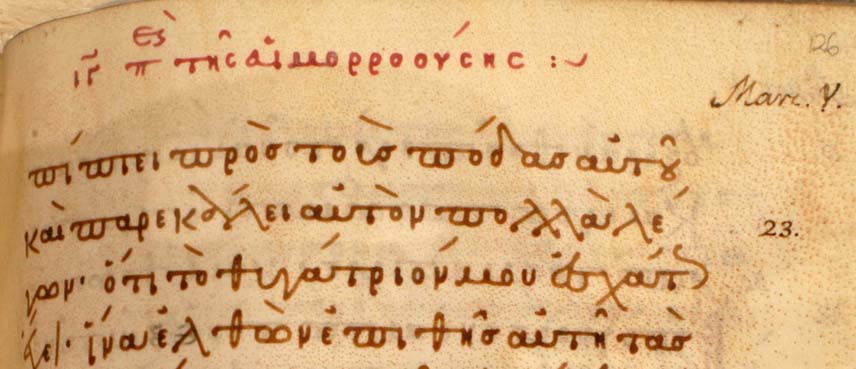
Excerpt from Gospel of Saint Mark showing Minuscule script with title rubricated 

I am certainly no expert on textual criticism, but I have been interested in the subject for many years. In a previous post, I outlined the case for reasoned eclecticism in New Testament textual criticism and I believe that approach is essentially valid. However, for a long time I'vne had some misgivings about the approach taken by current scholarship in how reasoned eclecticism treats the existing evidence.

New Testament textual criticism is a very complex and technical discipline. The fact is that there are around 5000 Greek manuscripts in existence at this time. They range from fragmentary scraps of papyrus with just a few verses through to a few containing all or almost all the New Testament. In age, they range from texts dating from the second century all the way through to some very late manuscripts dating from after the advent of the printing press. These Greek manuscripts are the most important witnesses to the original Greek readings. As no two handwritten manuscripts are exactly the same, the task of the critic is to assess what the most likely reading is in the original autographs (the documents the apostles originally wrote).

At the risk of oversimplifying matters, there are two broad approaches that are taken with the evidence. The vast majority of modern scholars favour what is called 'reasoned eclecticism.' There are a lot of principles and rules around this approach, but in practice, just as the scholarship has held since Westcott and Hort in the 19th century, the manuscripts are "weighted" rather than "counted" and so preference is given to the much smallers number of older manuscripts over the far greater number of later manuscripts. Time after time, when looking at places where there are textual variants, the modern critical Greek New Testaments (currently known as NA28 (Nestle-Aland 28th Edition) and UBS5 (United Bible Societies 5th Edition) go with the readings of three or four of what are deemed the most important manuscripts because they are older, against sometimes a thousand later manuscripts.

The second broad approach takes the opposite course, and gives greater weight to many later manuscripts against the very few earlier ones. Outside the Book of Revelation, which has its own particular textual issues, the split on textual variants is not even close. Most of the time fully 85-95% of the manuscripts point one way and 1-2% point the other way. This fact is probably at the heart of why I feel the original text is more likely to be in the Byztantine text—the text supported by  85-95% of the evidence, though admittedly by later manuscripts, and not in the criticual text with readings often supported by only handful (or even just one) of the oldest manuscripts.

The reasons for my valuing and in some cases preferring the Byzantine text is outlined as follows. Before going into that, we should make the point that the vast majority of the New Testament is the same whether we use the traditional Byzantine text or the critical editions that try to reconstruct the original text largely built on two manuscripts, known as Sinaiticus and Vaticanus along with some early supportive papyrii.

So here are my ten reasons:

1. The Text of the Vast Majority of the Manuscript Evidence

The first and most important reason for preferring the Byzantine or Majority Text over the critical text is that it is by far the text with the strongest support in the Greek manuscripts. The typical level of support in the manuscripts is 85-95% of the evidence being in its favour. By contrast, the critical text, in those places where there are meaningful textual variants, is often supported by less than 2% of the manuscripts and not infrequently by only one or two manuscripts. 

Absent some other intervening factor, the text that ended up in the vast majority of copies has an a priori claim to be most likely the original text.

This has been recognised at least implicitly by opponents of the Byzantine Text. For example, Westcott and Hort argued that the dominance of the Byzantine Text in the manuscript tradition and the comparative paucity of support for their favoured Alexandrian text had to be explained by their being an organised and deliberate recension of the text, making the most common Byzantine text and rejecting the Alexandrian text, which they believed was in fact closer to the original autographs. The problem is that there is no historical evidence that any such recension took place. Without it, there is no good reason to account for how the Byzantine text is so dominant in the manuscripts, unless it was the original text.

It is irksome that those who favour the critical text, which in many places, simply adopts the readings of two or three Alexandrian sources, especially Sinaiticus and Vaticanus and ignore thousands of Byzantine manuscripts, nevertheless trade on the fact that "we have 5000 manuscripts" of the New Testament when, in fact, they only really value a handful of early manuscripts where there are textual variants of note.

2. The Text Providentially Preserved by God 

We have not even begun to discuss the doctrine of "providential preservation" which is taught in the Reformed confessions. The Westminster Confession of Faith chapter 1.8 reads:

The Old Testament in Hebrew, (which was the native language of the people of God of old,) and the New Testament in Greek, (which, at the time of the writing of it was most generally known to the nations,) being immediately inspired by God, and by his singular care and providence kept pure in all ages, are therefore authentical;   so as in all controversies of religion, the Church is finally to appeal unto them. 

There are a couple of points worth noting here. The first and most important point is that for the Westminster divines, the inspired text of the New Testament was not a theoretical autograph that we are always aiming at, but never arriving at. When they talk about "the New Testament in Greek" they meant the Greek text they held in their hands and read. It was the actual text that existed at that time that they believed was "immediately inspired by God, and by his singular care and providence kept pure in all ages."

Now, while the textus receptus that underpinned the Geneva Bible, the King James Version and all the Protestant translations of the New Testament was the printed text of that time, the Byzantine Text found in the majority of manuscripts is only slightly different from this text, correcting the relatively few places where the TR does not have good Greek manuscript support.

However, this is quite different from the eclecticism of the critical texts, which require that far from the true text of the New Testament being "kept pure in all ages" this view requires that the true text was lost for almost 1500 years between the 4th century and the mid 19th century.

3. The Text with a wide geographical spread

The second arguement for the Byzantine text being the better text is that not only has it come down to us in the vast majority of manuscripts, but it also represents a wide geographical spread, being found in separate lines of transmission all over the Roman Empire, whereas the Alexandrian text in its older manuscripts has survived only in the area of Egypt, both in the great uncial manuscripts and the surviving papyrii.

Evidence from a wide geographical area is a second point in its favour. We may well ask why a text would be found over a wider geographical area as well as in most manuscripts reach that position unless it was copied many times and in many places by Christians who believed it to represent the true text of the New Testament. 

4. The Text that was actually in use by the Greek-speaking Church and Its Liturgy

Unlike the critical text which substantially relies on two obscure manuscripts, one rescued from destruction in a monastery in Egypt and the other kept in the Vatican library, the Byzantine text has been in use in the Greek-speaking church for over a thousand years. It is the text that has been influencing the life of the church all through the New Testament era. It is also the text that has been in use in the Protestant churches since the Reformation onwards.

5. The Text that has an internal consistency across sometimes hundreds of independent manuscripts 

The Byzantine text displays an extraordinary level of consistency and agreement across hundreds of manuscripts. While no two manuscripts are ever identical, each with its own scribal errors, nonetheless the Byzantine text is consistent. This is in sharp contrast with the two main Alexandrian uncials which hardly agree with one another in a single verse.

6. The Text that Fits the Fact that Scribes Tend to Omit Material More Often Than They Include Extra Material

One of the rules of modern textual criticism is that, all else being equal, the shorter text is to be preferred as more likely the original. However, many people are now questioning this. There is evidence that, in fact, scribes were more likely to omit material when copying rather than adding text. Such omissions would mostly be by accident, though perhaps sometimes deliberate.

The Byzantine readings are generally longer than the Alexandrian text. It seems quite arbitrary that assume the shorter reading is more likely original. In fact, I believe that the preference for the older manuscripts is the overarching reason that they are preferred. There are places where the longer reading is in the critical text. Here the critical text still goes with the older MSS.

The truth is that when handling what they believed was the Word of God, scribes were less likely to add to the text, which requires a deliberate action, whereas leaving something out can easily happen by accident. On this basis, we might infer that the longer text is more likely to be the original. 

7. The Text That Requires Unproven Conjectures to Undermine It

As we have already mentioned, unless there is some overriding reason to hold otherwise, the text that dominates the manuscripts—the text that has been copied the most—is statistically the most likely to be the original. Even the opponents of the Byzantine text recognise as much. This is why there have been a number of theories as to why they believe the secondary Byzantine text came to dominate whereas what they believe was the original text was all but lost. 

The most common of these theories is that at some point there was an official church recension or editing of the New Testament text, standardising it in the distinctly Byzantine direction.

However, no evidence of any such recension has been found. Absent this, there is no good reason to suppose that the vast majority of manuscripts are not the best indicator of the original text.

8. The Huge Amount of Comparatively Late Manuscripts Must Have Been Copied from Earlier Manuscripts

My next point is simply that the vast majority of manuscripts, representing the Byzantine text, did not come out of nowhere. Every manuscript that exists came from other earlier manuscripts. That is how copies are made. Studies show that the existing Byzantine manuscripts come from many lines of transmission. In other words, these manuscripts are not obvious copies of each other. They come form earlier, now lost, ancestor manuscripts.

An additional supporting point is that when written Greek shifted from the more difficult to read uncials (all written in capital letters with minimal punctuation and sometimes no spacing between words) to the more easy to read minuscules (such as the image at the top of this post), when copies were made into the minuscule form, scribes would then tend to destroy the earlier uncial version. This would explain why there are no existing Byzantine uncials.

The existence of some Byzantine readings among the papyrii is also an indication that the Byztantine text goes back in time much further than the existing manucscripts indicate.  

9. The Lack of Early Manuscripts Points to the Text Being in Constant Use 

Closely aligned with the previous point, as well as being deliberately destroyed when new copies were made, the text that was in constant use in the early church would naturally wear out and need replacing. The only reason the likes of Sinaiticus and Vaticanus survived was because they were not in constant use. They were not texts that the churches used.

Logically, we would not expect early manuscripts to survive of the text was being read and used in churches all over the Greek-speaking Roman Empire.

In other words, the lack of early manuscripts in the Byzantine form, is actually an argument in favour of the Byzantine text being in use at earlier points in church history prior to the dates of the surviving manuscripts.  

10. The Text of the Reformation and the Reformed Creeds

Though our final point is not a textual one and definitely the weakest of the arguments put forward, I do not think it insignificant that the Byzantine text was the one which God in his providence used throughout the Protestant Reformation and right through to the 19th century.

The fact is that in God's church, the Byzantine text was not really replaced in the churches until the 1950s when the RSV came into use.

The Reformed creeds are based around the New Testament text found in the Textus Receptus, itself a form of the Byzantine text.

Conclusions

At present, there are no committee translations of the Byzantine text (or Majority text). The only translatons are of the Textus Receptus, which departs from the majority Byzantine readings on a number of occasions. The main options are the King James Version and the New King James Version. The latter is particularly useful because the New Testament footnotes show there the majority text and the critical text differ from the TR.

There are two excellent translations produced by Robert Adam Boyd, a Wycliffe translator. One is a revision of the American Standard Version (1901) in which Boyd has changed the New Testament to conform to the Byzantine Text. The other is a fresh translation of the Byzantine Text into modern English, which Boyd calls the Text-Critical English New Testament: Byzantine Text Version. This version reads similarly to the ESV or Christian Standard Bible in terms of the translation style.

It would be very useful if a Byzantine version of the ESV or NIV could be produced. Most of the key readings would be found in the footnotes of these versions anyway.

The World English Bible (WEB) which is another public domain translation, is also based on the Byzantine text. 

Thursday, 27 November 2025

The Case for Reasoned Eclecticism (in New Testament Textual Criticism)

https://support.bl.uk/DynamicImages/8243638d-01fc-4f9e-ba3a-9e8d0170f293/Codex-Sinaiticus-ff244v-245--Open-at-St-Lukes-Gospel-chapter-22-20-71-chapter-23-1-13.JPG?width=1024
Codex Sinaiticus, 4th Century Greek Manuscript

Few topics stir as much debate among Christians, historians, and biblical scholars as the question of how we determine the original text of the New Testament. I am certainly no expert on textual criticism, but I have been interested in the subject for many years and here are where my thoughts on this subject have taken me so far.

Let's start with a few facts that are not in dispute. The books of the New Testament were originally penned by the apostles and the originals they produced are called the autographs. In God's wisdom, we no longer possess the original autographs—all have been lost in time, and so none can be venerated by Christians. We do not possess the autographs, but we do possess over 5,800 Greek manuscripts and thousands more in ancient translations, especially Latin. 

The sheer abundance is a blessing and vastly exceeds the manuscript evidence for any other work of antiquity. Yet this abundance of manuscripts also presents a challenge. Prior to the advent of the printing press in the Renaissance period, every copy of the New Testament had to be laboriously copied by hand. As a result, all manuscripts differ in places with every other manuscript in thousands of ways. Most of these are tiny and largely inconsequential such that they would not even show up in an English translation (spellings, word order, etc.). However, there are hundreds of places where the manuscripts' differences do affect the text—none are so significant that they seriously affect any doctrine—but they do result in potentially different readings within the New Testament. These are known as "textual variants". In modern bibles, you will find them on most pages of the New Testament, where the main text reads one way, but footnotes present alternative possibilities. 

The question is: How do we decide which reading is most likely the original?

There are a number of different schools of thought among scholars as to how best to answer this question. 

The most widely used and academically respected approach today is known as reasoned eclecticism. This method stands behind the standard critical editions that lie behind almost all mainstream English translations. These are called the NestlĂ©-Aland 28th Edition and the United Bible Societies 5th Edition (known as NA28 and UBS5).

While no method is perfect, reasoned eclecticism offers the most balanced and historically sensitive way to reconstruct the earliest recoverable and most likely original text.

Though not an essential part of reasoned eclecticism per se I think it is also worth stating that my personal view is that the text of the autographs, the actual words of the apostles that are God-breathed (2 Timothy 3:16), have not been lost, but are to be found in the manuscript evidence God has providentially preserved. The true reading is to be found either in the main printed text or the footnotes of our bibles.

The other thing I would want to add is that there are sometimes when I believe the academic consensus on what the most likely original reading is may be incorrect. Reasoned eclecticism leaves it open to each person to study the evidence, consider the arguments, and make up their own mind. Some may complain this leaves uncertainty as to the original text, but I would simply reply that it is the existence of textual variants in the text that creates this uncertainty. Reasoned eclecticism simply embraces the facts. Other approaches seem to want to trade truth for certainty and may end up with neither.

The following are the main reasons why I believe that reasoned eclecticism is the best approach to New Testament textual criticism.

1. Reasoned Eclecticism Uses ALL the Manuscript Evidence, Not Just Part of the Evidence

Some approaches prioritize the numerical majority of extant manuscripts (known as the Majority Text or Byzantine Priority Approach), and others almost exclusively privilege a single text type (as in some Alexandrian-priority arguments). Reasoned eclecticism avoids both extremes.

It considers:

  • External evidence: the age, geographical distribution, and textual relationships of manuscripts.
  • Internal evidence: what scribes tended to do, and what an author is likely to have written.

By drawing from the full spectrum of available data: papyri, uncials, minuscules, versions, and patristic citations. It avoids the tunnel vision that comes from using only one subset of the evidence.

Reasoned eclecticism makes the simple but essential claim: the original reading is more likely to survive in the oldest manuscripts, all other factors being equal. Thus the witness of a few oldest sources is at least if not more valuable that a large majority of later manuscripts. Fundamental to this approach is the recognition that manuscripts must be weighed and not just counted. Secondly, where the external evidence is not clear-cut, we must examine the internal evidence and a judgment is needed to assess which reading is (a) least likely a scribal error or addition and (b) is the variant that most likely explains the existence of the other variants.

2. Reasoned Eclecticism Recognises That Manuscript Numbers Alone Cannot Determine Originality 

Most New Testament manuscripts were copied in the Byzantine Empire after the 9th century. They are numerous not because they preserve the earliest form of the text, but because Byzantine copying was prolific and stable. A reading supported by a thousand manuscripts from AD 1000 may be historically inferior to a reading supported by two manuscripts from AD 200.

Reasoned eclecticism therefore avoids the fallacy that “more manuscripts = more original.” Instead, it asks: Which manuscripts stand closer to the earliest recoverable stages of transmission? Often, the early papyri from Egypt represent earlier streams of copying, even if they are fewer in number.

Quality, not quantity, is what matters then sifting the available evidence.

3. Reasoned Eclecticism Acknowledges Scribal Habits (Both Errors and Expansions)

Copyists made predictable mistakes. For example, they tended to:

  • Expand names and titles for clarity (“Jesus Christ” → “the Lord Jesus Christ”).
  • Simplify grammar or wording.
  • Harmonize parallel passages (both in the Gospels and in Paul's Letters).
  • Add explanations to difficult verses or soften verese thought to be too hard.
  • Add marginal notes into the body of the text for fear of leaving out anything important.

Reasoned eclecticism takes these tendencies seriously. A reading that is more awkward, shorter, or harder is often more likely to be original because scribes typically smoothed and expanded rather than created difficulties. No other method consistently accounts for this behaviour by those who copied the New Testament by hand.

4. Reasoned Eclecticism Takes Account of Authorial Style and Context

Not every variant is best explained by scribal habits alone. Sometimes one reading simply fits better with the vocabulary, theological themes, or narrative flow of the author.

For example, Johannine vocabulary is distinctive. If a variant reading uses terms foreign to John’s style, reasoned eclecticism recognises that it may be secondary. Likewise, if a variant disrupts the flow of argument, that too must be weighed.

Reasoned eclecticism gives us the freedom to integrate literary and contextual insights alongside manuscript evidence.

5. Reasoned Eclecticism Avoids Rigid Formulas and Instead Balances Probabilities

Some text-critical methods operate with simplistic rules, such as “prefer the shorter reading,” or “prefer the reading with majority support.” Reasoned eclecticism explicitly rejects such wooden approaches. Instead, it weighs evidence case by case, instance by instance, recognising that real historical transmission is complex.

This does mean scholars sometimes disagree. But disagreement is not a weakness—it’s a sign that the method is flexible, honest, and evidence-driven rather than ideology-driven.

Far from being a weakness, the fact that some conclusions have to be tentative and open to correction is a strength of the approach.

6. Reasoned Eclecticism Helps Explain Why Some Famous Passages are Disputed

Reasoned eclecticism is the method behind scholarly discussions of passages such as:

  • Mark 16:9–20 ("The Longer Ending of Mark")
  • John 7:53–8:11 ("The Pericope Adulterae"
  • The Ending of the Lord’s Prayer in Matthew 6
  • John 5:4 (The Pool of Bethsaida) 
  • Luke 2:14 
  • 1 Timothy 3:16
  • Romans 8:1 
  • 1 John 5:7-8 ("The Comma Johanneum") 

And many other passages. 

In each case, reasoned eclecticism weighs early manuscripts, later manuscripts, scribal habits, authorial style, and historical plausibility. Sometimes the result is that a well-known reading is judged secondary. That can be uncomfortable, but it is honest.

The methodology also allows scholars and readers to judge the evidence and make up their own mind. No one is forced to accept the majority opinion on any of these variants. 

A method that never challenges traditional readings is not a historical method; it is a theological one. Reasoned eclecticism prioritises evidence over tradition while still respecting the beliefs of the Christian community.

Again, we would point out that no doctrine relies solely on a particular variant in the manuscript tradition.

7. Reasoned Eclecticism Underlies All Modern Critical Editions of the Greek New Testament 

The NA28 and UBS5 — the two standard editions of the Greek New Testament used worldwide — are both products of reasoned eclecticism. These editions are the basis of almost every major modern translation (NIV, ESV, NRSV, CSB, NASB, and others). They represent over a century of collaborative international scholarship.

No other method has produced texts as widely accepted, rigorously tested, and transparently documented.

8. Reasoned Eclecticism Aligns with How Historians Approach Other Ancient Literature

Classical scholars who edit texts like Homer, Plato, or Tacitus also use eclectic principles: they weigh manuscript age, geographic spread, internal coherence, and scribal tendencies. Reasoned eclecticism places New Testament textual criticism within the mainstream of responsible historical method, not outside it.

This does not mean that Christians do not acknowledge a vast difference between Scripture and all other writings. Of course we acknowledge the New Testament is theopneustos ("God-breathed") and as such is inerrant and infallible.

Yet, the robust process of seeking out the original text from the manuscript evidence, and showing that it can be done to an extraordinary level of certainty, is immensely helpful apologetically when engaging with non-Christians. We do not rely on bare claims of faith when establishing the text of Scripture. It can be done using principles that are valid whether the textual critic is a believer or not. This means that the text of Scripture can be accepted as accurate by anyone coming to it honestly. The truth is that 94-95% of the text of the New Testament is beyond doubt original and certain. All major doctrines and practices are clearly taught whatever Greek Text we use. The question of which text is more likely original only has a bearing on 5-6% of the text, and of these perhaps only 1-2% have any real significance at all beyond spellings and word order or saying the same thing in slightly different words.

Conclusions 

Reasoned eclecticism is not perfect—no method is—and it does not claim to be. But it is the approach that most responsibly engages with the full range of available evidence. It avoids the pitfalls of majority-based methods, sidesteps the rigidity of one-text-type theories, and resists simplistic rules. By considering external evidence and internal probabilities together, it offers the most historically plausible reconstruction of the earliest recoverable New Testament text.

In short, reasoned eclecticism gives us the best chance of hearing the New Testament as the earliest Christian communities heard and read it.

Tuesday, 8 October 2024

We Need Another Bible Translation

You might be forgiven for thinking that the last thing we need is ye t another Bible translation in English. There are already a plethora or committee and single-author translations of the whole Bible or the New Testament.

There are some 56 versions available on the Biblegateway website alone. There are estimated to be somewhere around 900 English translations in total of either the whole Bible or the New Testament.

There are translations of every stripe from the historical King James Version on the one hand to "The Message" paraphrase on the other.

There are MANY excellent mainstream translations widely available in print or online including the King James Version, Revised Standard Version, New Amercian Standard Bible, New King James Version, New International Version, New Revised Standard Version, Revised English Bible, Christian Standard Bible, New Living Translation and others.

Why on earth would anyone claim we need another one?

I have one good reason why we could do with at least one more.

Of all the versions widely available today and produced by a translation committee as opposed to the work of a single individual, there are two based on the historic Textus Receptus Greek New Testament (this is the text published at the time of the Reformation and on which the King James Version is based - as well as similar translations in other languages such as Luther's Bible in German). These are the King James Version (1611) and the New King James Verion (1982). The Textus Receptus reflects the majority of Greek manuscripts most of the time, but also includes a number of "minority" readings, and a few with little or no Greek support at all.

All other modern committee translations are based on what is known as the "Critical text" of the New Testament. The critical text, in places where there are textual variants in the Greek, tends to follow a low number of the oldest manuscripts rather than vast majority of Greek manuscripts.

There are currently NO versions produced by a committee based entirely on what could be called either the Majority Text or the Byzantine Text. This Greek text reproduces the text which the great majority of Greek manuscripts contain. In most variants, the Byzantine Text represents 95% or more of the existing Greek manuscripts. The Critical Text tends to accept the evidence of a very small number of witnesses (sometimes as little as one or two manuscripts) and often under 5% of the manuscripts.

The difficulty is that the oldest manuscripts that tend to be given more weight by textual critics are few in number while the Byzantine Text has the support of the great majority of manuscripts, but these are later in date. Which one is favoured is a complex issue. The question is which text represents to original authentic text? Is the few earliest witnesses (1-5% of the Greek evidence) or the majority of later witness (frequently 95%+ of the Greek manuscripts)?

I have always found it difficult to accept that the correct original text lay largely undiscovered to the church at large for over a thousand years before being recovered in the 19th century and reconstructed over the course of 100 years from the 1880s onwards. Equally, I find it very difficult that when the manuscripts are examined, often 95-99% of manuscripts are deemed WRONG (even where they frequently agree with one another) and the correct text is deemed to be found in a small handful of early manuscripts. Yet all modern translations widely available are based on this Critical Text (except the NKJV as noted).

To give a couple of examples to show how the weight of the evidence is ignored in many modern translations, consider these examples from the Gospels:

Luke 2:14

NIV: "Glory to God in the highest heaven, and on earth peace to those on whom his favour rests."

ESV: "Glory to God in the highest, and on earth peace among those with whom he is pleased."

The NIV does not even footnote this, while the ESV footnote says that "some manuscripts" read "peace, good will among men."

The truth is that the ESV and NIV readings are based on around 0.4% of the manuscripts, and the "some manuscripts" represent 98.8% of the available evidence.

Here, the Textus Receptus underying the KJV follows the majority Byzantine text and reads in the familiar words:

"Glory to God in the highest, and on earth peace, good will toward men."

Matthew 6:13

Most modern translations end the Lord's prayer at "deliver us from evil" (ESV) or "deliver us from the evil one" (NIV).

The NIV footnote says "Some late manuscripts" read "for yours is the kingdom and the power and the glory for ever. Amen"

The ESV says "Some manuscripts add" before quoting the familiar ending.

Note the choice of words - "some", "late" and "add".

In fact, 92.6% of manuscripts have the extended ending to the prayer and only 1.2% lack it. 90% of anything is not "some". At the very least the footnotes should say "most" not "some".

John 3:13

Here the NIV reads: "No one has ever gone into heaven except the one who came from heaven—the Son of Man."

ESV is similar: "No one has ascended into heaven except he who descended from heaven, the Son of Man."

The footnotes here read in the NIV that "some manuscripts" read "the Son of Man, who is in heaven."

ESV footnote: "Some manuscripts add..."

Here only 1.1% of manuscripts omit the extra words and 97.6% of manuscripts support having the extra words.

The NKJV reads, following the Textus Receptus and by extension the Byzantine majority text:

"No one has ascended to heaven but He who came down from heaven, that is, the Son of Man, who is in heaven."

There are hundreds of such texts in the New Testament where we are told that "some" or "a few" manuscripts read something which really means the overwhelming majority of Greek manuscripts favour the footnoted text.

So beware the footnotes in most bibles, they can be misleading as to the balance of the evidence.

Yet my point is not really which Greek text is more likely to be the original. The point is that it would be very useful to have a good English translation of this Majority or Byzantine text that reflects what by far the most Greek manuscripts indicate.

There are some good one-man translations out there, but they have the limitations and biases of the translator, and are unlikely to have a large impact on the churches.

I think it would be good to have a formal equivalent translation of the Byzantine text produced by a qualified committee of translators and backed up with the resources needed to get the translation on the main bible websites as well as produce a range of hard copies such as we have from Crossway for the ESV or Zondervan for the NIV.

If you are interested in an English translation from the Byzantine text there is one I would recommend and that is the "The Text Critical English New Testament" translated by one man, Robert Adam Boyd. I am grateulf to Boyd's work which not only translates the Majority text but has extensive footnotes on how this compares to a number of other Greek texts including the Textus Receptus and the Critical Text. The percentages referred in my examples come from this NT edition.

I would recommend reading Boyd's version alongside either the New King James Version, which also has good textual notes though not fully comprehensive, and the NIV or ESV to see where the variations lie and the real percentages of evidence rather that the misleading notes too frequently used in our main translations.

Saturday, 25 March 2023

Trading Truth for Certainty

P46 - one of the earliest New Testament Manuscripts dating from 175-225AD

I listen fairly regularly to James White's YouTube channel, The Dividing Line. For those who don't know, Dr White is an American Reformed Baptist best known for his apologetics ministry and his many debates with Mormons, Muslims, Roman Catholics and others. One area where White has debated many times is King James Onlyism. This is a spectrum of views prevalent in certain sections of American evangelicalism ranging from the belief that the King James Version is the only translation we should use because it is the best, through to more whacky views such as the KJV was itself inspired by God and therefore takes precedence even over the Hebrew and Greek manuscripts. 

James White has argued against these views for many years and his book, The King James Only Controversy is a leading work in refuting such views. I commend that book to you if this is an area you are concerned about. White defends the scholarly eclectic Greek New Testament text that underlies most modern translations since 1881, over the Textus Receptus of the 15th century on which the King James Version was based.

In a discussion on King James Onlyism, James White used a phrase that has stuck with me since I heard it. He said that those who defend the King James Version and the Textus Receptus Greek text underlying its New Testament have traded truth for certainty. 

What an interesting concept! Trading truth for certainty. I think White is correct in pointing his finger right at this spot on KJV Onlyism. The issues are complex, but in essence, a theme emerges in most KJV-only advocates. They believe the text of Scripture is God-breathed and therefore infallible and inerrant. And these beliefs are good and true—and shared with almost all evangelicals including James White and myself. But there's a problem. 

The fact that for the first 1500 years of its existence, the text of the New Testament was copied by hand, first from the original autographs (the actual manuscripts written by the apostles) and then onwards, copies from copies, to produce thousands of copies of the New Testament used all over the churches of Africa, Asia and Europe. Indeed, it wasn't till the invention of the photocopier in 1949 that human beings had the capacity to reproduce exactly a written text from one copy to another. Each time a document, particularly a lengthy document like a book, is hand copied, even when done with great care, mistakes are made. It is unavoidable.

At the present time we have over 5000 of these ancient manuscripts still in existence and no two copies are identical. This means that the Greek text of the New Testament has many textual variants or readings in certain verses. Far from being a source of disappointment or doubt, this is actually a wonderful example of God's providential care of the text of the Bible. These 5000 Greek manuscripts, as well as thousands of manuscripts in Latin and other ancient languages, some of almost all the New Testament, some fragments of just a few verses are a tremendous witness to the true text of the New Testament. The New Testament is by far the best attested work of antiquity, but there are still textual variants that exist.

I don't want to overemphasise these differences. Most variants do not affect the meaning, especially in English translation, because most variants are things like word order, spellings, and omissions or additions of words that don't affect or even show up in translation. We can be certain of around 98-99% of the text of the New Testament. But that leaves 1-2% where the variants do reflect differences in meanings that would affect translations.

The King James Version, translated in 1611, was based on the Textus Receptus - the form of the Greek text published in the 16th century. That Greek text reflected the Greek manuscripts Erasus, Stephanus and Beza had to work with at that time. And it is in the main a Greek text reflected in the majority of Greek manuscripts in existence, but most are late in date, from around 1000-1400 AD.

In centuries after the KJV was published, many earlier manuscripts have been discovered. Though there are fewer of them, we now have manuscripts that go back to the 3rd or 4th century AD, some as early as maybe a hundred years after the apostles wrote the originals.

The questions for textual scholars is always "What did the apostles actually write?" Although I'm simplifying a bit, in general the issue is whether the correct reading in a textual variant is to be found in a smaller number of early manuscripts, written closer to the time of the apostles, or in the larger number of later manuscripts, written nearly a thousand years or more later. The scholarly decision on these issues can be difficult and complex, involving careful detective work both on external evidence—the age and quality of the manuscripts themselves—and internal evidence regarding the language itself, to decide what was the most likely original text based on many different factors.

Now, here is where the issue of trading truth for certainty comes in. The KJV-only advocates want to be absolutely certain of the content of their God-breathed, infallible text, and so they basically say that textual questions were settled in the Textus Receptus. They tend to argue that God providentially arranged that text to be the basis of the translations produced at the Reformation (including the KJV though it was a bit later) and regard other variants as deviant.

So they can have a text with certainty. But in doing so they having traded off against truth. For the truth is that the textual variants do exist, and the fact is that the earlier manuscripts though clearly bearing witness to largely the same New Testament text, does tend to be slightly shorter and contain perhaps more "difficult" readings.

Perhaps a few examples might be helpful at this point to show the kind of differences that exist. In these examples "TR/MT" means the Textus Receptus or Majority Text and "CT" means the eclectic Critical Text with the key words in bold.

Matthew 6:13 (The last part of the Lord's Prayer):

TR/MT: "And lead us not into temptation, but deliver us from evil. For yours is the kingdom, the power and the glory forever. Amen."

CT: "And lead us not into temptation, but deliver us from evil." (Omits the rest of the verse)

John 1.18

TR/MT: "No one has seen God at any time. The one and only Son, who is in the bosom of the Father, has made him known."

CT: "No one has seen God at any time. The one and only [who is] God, who is in the bosom of the Father, has made him known."

John 3:13

TR/MT: "No one has ascended to heaven except him who descended from heaven, even the Son of Man, who is in heaven."

CT: "No one has ascended to heaven except him who descended from heaven, even the Son of Man." (omits the last phrase)

1 Timothy 3:16

TR/MT: "Great is the mystery of godliness: God was revealed in the flesh..."

CT: "Great is the mystery of godliness: [He] who was revealed in the flesh..."

There are hundreds of similar textual variants throughout the New Testament. Most modern translations include one reading in the main text and one or more variants in footnotes, allowing the reader to see the main variants and decide which they think was the original reading. We can be reasonably certain that the original is either in the main text or the footnotes. This option essentially trades certainty for truth. The alternative, as advocated by many in the KJV-only side of the debate, is to just have the KJV text with no textual variants in footnotes, choosing an apparent certainty over the truth.

As I believe I will have made clear, I think we should favour truth over a false or apparent certainty.