
For many years, I have wrestled with hell. By that I mean the doctrine of the final state of the wicked.
There are a spectrum of views, of course, on this subject, but in my view it comes down to two main views among evangelicals. A third view, that ultimately everyone will be saved (known as "universalism") is not supported by more than a tiny minority of those claiming to be evangelical. That leaves two views among evangelicals.
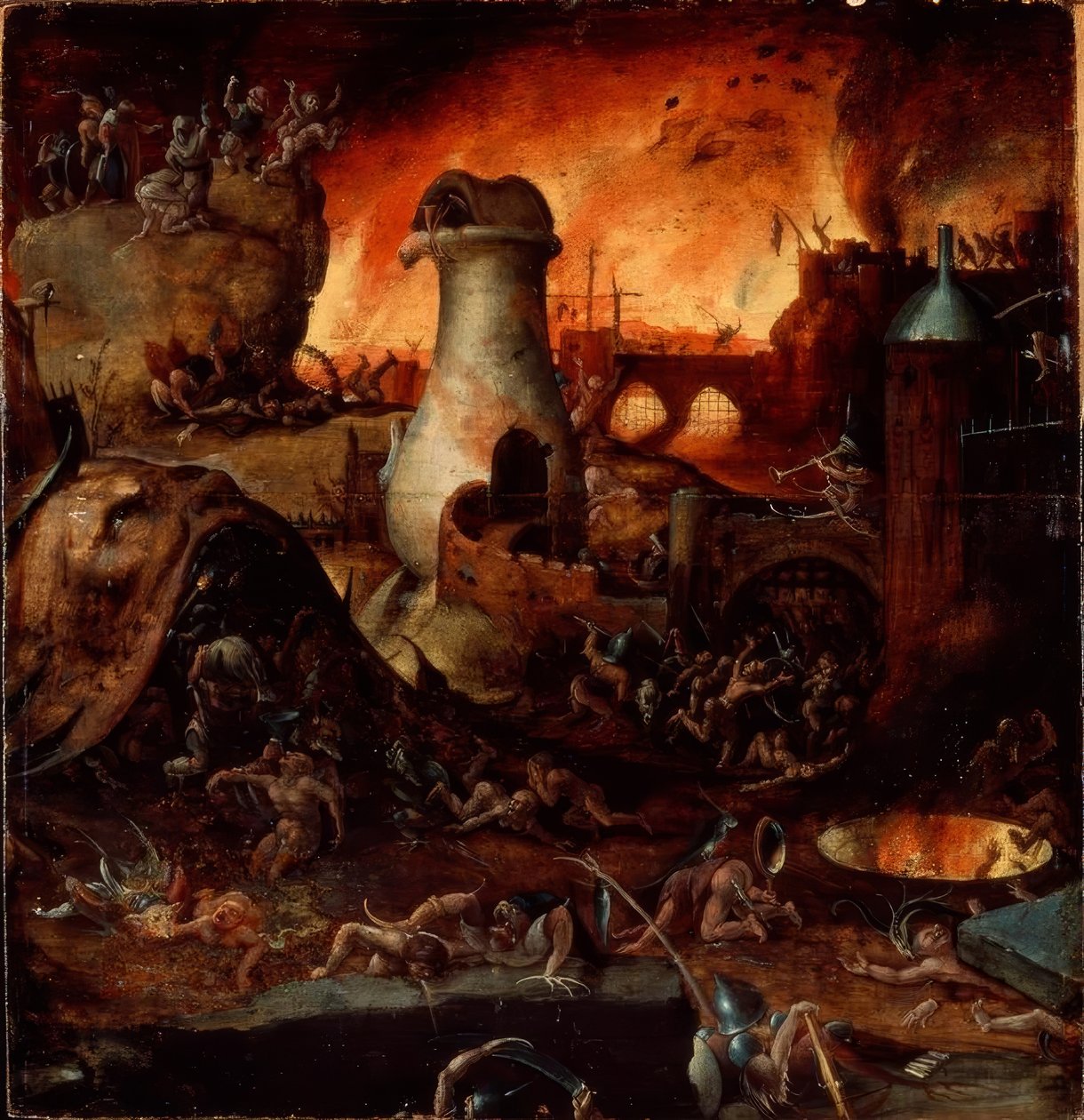
First, there is what is known as the traditional view that the final state of the non-saved is eternal conscious torment and punishment in hell. This view is almost inconceivable for the human mind to comprehend. For a person to experience punishment and, in some sense, pain, for all eternity is an idea so horrific that I think few of us want to even contemplate it. The exact details are sketchy at best biblically - darkness, fire, pain, torment, certainly much less detailed than the vivid medieval depictions of the likes of Dante in writing and Bosch in art.
Nevertheless, it is the most common view held by Reformed and evangelical Christians and there are a number of strong biblical arguments in its favour. It is also the view taught in the Reformed confessions.
Several verses are difficult to reconcile with the idea that the punishment in hell is only temporary in duration.
Matthew 25:46 is one such verse where Jesus himself says: "These [the wicked] shall go away into eternal punishment, but the righteous into eternal life."
Notice he does not say "eternal death" in contrast to eternal life, but "eternal punishment". At least on the face of it, if eternal life is never ending, it would appear that eternal punishment may be never ending also.
A second verse of relevance is Revelation 14:10-11, speaking of those who worship "the beast": "He also will drink the wine of God's wrath, poured full strength into the cup of his anger, and he will be tormented with fire and sulphur in the presence of the holy angels and in the presence of the Lamb. And the smoke of their torment goes up for ever and ever, and they have no rest, day or night, these worshippers of the beast and its image, and whoever receives the mark of its name."
"The smoke of their torment goes up for ever and ever" does not sound like annihilation to me.
A third relevant passage is Revelation 20:10 and 15. "The devil who deceived them was thrown into the lake of fire and sulfur, where the beast and the false prophet are also. They will be tormented day and night forever and ever.... If anyone was not found written in the book of life, he was cast into the lake of fire."
Again, on the face of it, it could be argued that since the lake of fire seems to inflict torment forever, and all the wicked are thrown in there, their suffering would be eternal.
The second view has several different names, but in essence it is that while there is punishment in hell for the wicked, at some point the conscious torment ends and the person in hell ceases to exist. This view is sometimes called "Conditional Immortality" or "Annihilationism". It is sometimes portrayed as if this view teaches that when the wicked die, they immediately cease to exist. There may be some who teach that, but the mainstream of this view is that the wicked are punished in hell for a period of time related to the punishment they deserve for their sins, but that this punishment does not continue forever, but eventually they cease to exist.
In the first view, if a sinner is tormented in hellfire for a million years, he is no nearer the end of his infinite punishment than when he first entered hell. In the second, if the just punishment is punishment for a million years, at the end of this time, the sinner ceases to exist and the active punishment ends, though the sentence of eternal death remains effective forever.
Like many theological disputes, and perhaps more than most, there are good biblical arguments on both sides. Anyone who thinks that the opposite side in this discussion does not have good arguments, simply does not understand the best arguments of the other side.
It is unlikely we will ever be able to be certain about which view is correct this side of eternity. I admit that I cannot really conceive what eternal active punishment looks like. For that matter, I can hardly conceive what everlasting life looks like either. Part of me hopes that annihilationism is true. There may be people I love in hell after all. Eventual non-existence seems more attractive than eternal existence in suffering. As many have pointed out, how can the saints fully rejoice in heaven, knowing their loved ones are writhing forever in the pain of hell?
Yet we must not let our emotions guide our doctrine, but the teaching of the Word of God. And as we have seen, there are certainly verses that point in the direction of eternal conscious punishment.
All I can say is: "Shall not the judge of all the earth do right?" (Genesis 18:25). Whatever God does with the wicked will be the right thing in the end and it will be marvellous in our eyes (Psalm 118:23) because the fate of the wicked whatever else it is, will be according to divine justice.

No comments:
Post a Comment