Showing posts with label The Bible. Show all posts

Saturday, 3 January 2026

Why I Value the Byzantine Text of the New Testament

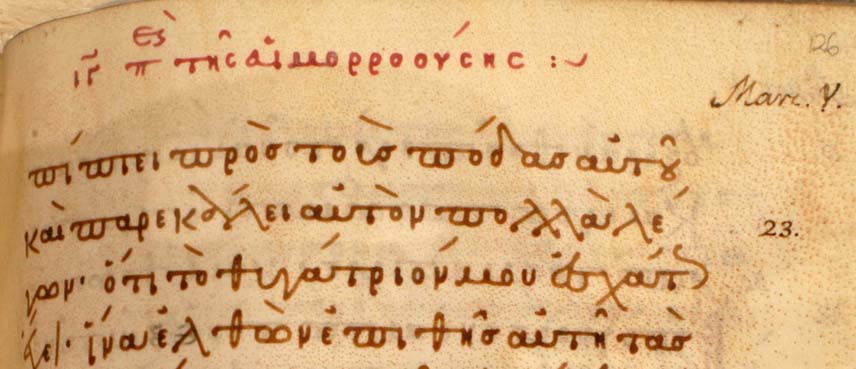
Excerpt from Gospel of Saint Mark showing Minuscule script with title rubricated 

I am certainly no expert on textual criticism, but I have been interested in the subject for many years. In a previous post, I outlined the case for reasoned eclecticism in New Testament textual criticism and I believe that approach is essentially valid. However, for a long time I'vne had some misgivings about the approach taken by current scholarship in how reasoned eclecticism treats the existing evidence.

New Testament textual criticism is a very complex and technical discipline. The fact is that there are around 5000 Greek manuscripts in existence at this time. They range from fragmentary scraps of papyrus with just a few verses through to a few containing all or almost all the New Testament. In age, they range from texts dating from the second century all the way through to some very late manuscripts dating from after the advent of the printing press. These Greek manuscripts are the most important witnesses to the original Greek readings. As no two handwritten manuscripts are exactly the same, the task of the critic is to assess what the most likely reading is in the original autographs (the documents the apostles originally wrote).

At the risk of oversimplifying matters, there are two broad approaches that are taken with the evidence. The vast majority of modern scholars favour what is called 'reasoned eclecticism.' There are a lot of principles and rules around this approach, but in practice, just as the scholarship has held since Westcott and Hort in the 19th century, the manuscripts are "weighted" rather than "counted" and so preference is given to the much smallers number of older manuscripts over the far greater number of later manuscripts. Time after time, when looking at places where there are textual variants, the modern critical Greek New Testaments (currently known as NA28 (Nestle-Aland 28th Edition) and UBS5 (United Bible Societies 5th Edition) go with the readings of three or four of what are deemed the most important manuscripts because they are older, against sometimes a thousand later manuscripts.

The second broad approach takes the opposite course, and gives greater weight to many later manuscripts against the very few earlier ones. Outside the Book of Revelation, which has its own particular textual issues, the split on textual variants is not even close. Most of the time fully 85-95% of the manuscripts point one way and 1-2% point the other way. This fact is probably at the heart of why I feel the original text is more likely to be in the Byztantine text—the text supported by  85-95% of the evidence, though admittedly by later manuscripts, and not in the criticual text with readings often supported by only handful (or even just one) of the oldest manuscripts.

The reasons for my valuing and in some cases preferring the Byzantine text is outlined as follows. Before going into that, we should make the point that the vast majority of the New Testament is the same whether we use the traditional Byzantine text or the critical editions that try to reconstruct the original text largely built on two manuscripts, known as Sinaiticus and Vaticanus along with some early supportive papyrii.

So here are my ten reasons:

1. The Text of the Vast Majority of the Manuscript Evidence

The first and most important reason for preferring the Byzantine or Majority Text over the critical text is that it is by far the text with the strongest support in the Greek manuscripts. The typical level of support in the manuscripts is 85-95% of the evidence being in its favour. By contrast, the critical text, in those places where there are meaningful textual variants, is often supported by less than 2% of the manuscripts and not infrequently by only one or two manuscripts. 

Absent some other intervening factor, the text that ended up in the vast majority of copies has an a priori claim to be most likely the original text.

This has been recognised at least implicitly by opponents of the Byzantine Text. For example, Westcott and Hort argued that the dominance of the Byzantine Text in the manuscript tradition and the comparative paucity of support for their favoured Alexandrian text had to be explained by their being an organised and deliberate recension of the text, making the most common Byzantine text and rejecting the Alexandrian text, which they believed was in fact closer to the original autographs. The problem is that there is no historical evidence that any such recension took place. Without it, there is no good reason to account for how the Byzantine text is so dominant in the manuscripts, unless it was the original text.

It is irksome that those who favour the critical text, which in many places, simply adopts the readings of two or three Alexandrian sources, especially Sinaiticus and Vaticanus and ignore thousands of Byzantine manuscripts, nevertheless trade on the fact that "we have 5000 manuscripts" of the New Testament when, in fact, they only really value a handful of early manuscripts where there are textual variants of note.

2. The Text Providentially Preserved by God 

We have not even begun to discuss the doctrine of "providential preservation" which is taught in the Reformed confessions. The Westminster Confession of Faith chapter 1.8 reads:

The Old Testament in Hebrew, (which was the native language of the people of God of old,) and the New Testament in Greek, (which, at the time of the writing of it was most generally known to the nations,) being immediately inspired by God, and by his singular care and providence kept pure in all ages, are therefore authentical;   so as in all controversies of religion, the Church is finally to appeal unto them. 

There are a couple of points worth noting here. The first and most important point is that for the Westminster divines, the inspired text of the New Testament was not a theoretical autograph that we are always aiming at, but never arriving at. When they talk about "the New Testament in Greek" they meant the Greek text they held in their hands and read. It was the actual text that existed at that time that they believed was "immediately inspired by God, and by his singular care and providence kept pure in all ages."

Now, while the textus receptus that underpinned the Geneva Bible, the King James Version and all the Protestant translations of the New Testament was the printed text of that time, the Byzantine Text found in the majority of manuscripts is only slightly different from this text, correcting the relatively few places where the TR does not have good Greek manuscript support.

However, this is quite different from the eclecticism of the critical texts, which require that far from the true text of the New Testament being "kept pure in all ages" this view requires that the true text was lost for almost 1500 years between the 4th century and the mid 19th century.

3. The Text with a wide geographical spread

The second arguement for the Byzantine text being the better text is that not only has it come down to us in the vast majority of manuscripts, but it also represents a wide geographical spread, being found in separate lines of transmission all over the Roman Empire, whereas the Alexandrian text in its older manuscripts has survived only in the area of Egypt, both in the great uncial manuscripts and the surviving papyrii.

Evidence from a wide geographical area is a second point in its favour. We may well ask why a text would be found over a wider geographical area as well as in most manuscripts reach that position unless it was copied many times and in many places by Christians who believed it to represent the true text of the New Testament. 

4. The Text that was actually in use by the Greek-speaking Church and Its Liturgy

Unlike the critical text which substantially relies on two obscure manuscripts, one rescued from destruction in a monastery in Egypt and the other kept in the Vatican library, the Byzantine text has been in use in the Greek-speaking church for over a thousand years. It is the text that has been influencing the life of the church all through the New Testament era. It is also the text that has been in use in the Protestant churches since the Reformation onwards.

5. The Text that has an internal consistency across sometimes hundreds of independent manuscripts 

The Byzantine text displays an extraordinary level of consistency and agreement across hundreds of manuscripts. While no two manuscripts are ever identical, each with its own scribal errors, nonetheless the Byzantine text is consistent. This is in sharp contrast with the two main Alexandrian uncials which hardly agree with one another in a single verse.

6. The Text that Fits the Fact that Scribes Tend to Omit Material More Often Than They Include Extra Material

One of the rules of modern textual criticism is that, all else being equal, the shorter text is to be preferred as more likely the original. However, many people are now questioning this. There is evidence that, in fact, scribes were more likely to omit material when copying rather than adding text. Such omissions would mostly be by accident, though perhaps sometimes deliberate.

The Byzantine readings are generally longer than the Alexandrian text. It seems quite arbitrary that assume the shorter reading is more likely original. In fact, I believe that the preference for the older manuscripts is the overarching reason that they are preferred. There are places where the longer reading is in the critical text. Here the critical text still goes with the older MSS.

The truth is that when handling what they believed was the Word of God, scribes were less likely to add to the text, which requires a deliberate action, whereas leaving something out can easily happen by accident. On this basis, we might infer that the longer text is more likely to be the original. 

7. The Text That Requires Unproven Conjectures to Undermine It

As we have already mentioned, unless there is some overriding reason to hold otherwise, the text that dominates the manuscripts—the text that has been copied the most—is statistically the most likely to be the original. Even the opponents of the Byzantine text recognise as much. This is why there have been a number of theories as to why they believe the secondary Byzantine text came to dominate whereas what they believe was the original text was all but lost. 

The most common of these theories is that at some point there was an official church recension or editing of the New Testament text, standardising it in the distinctly Byzantine direction.

However, no evidence of any such recension has been found. Absent this, there is no good reason to suppose that the vast majority of manuscripts are not the best indicator of the original text.

8. The Huge Amount of Comparatively Late Manuscripts Must Have Been Copied from Earlier Manuscripts

My next point is simply that the vast majority of manuscripts, representing the Byzantine text, did not come out of nowhere. Every manuscript that exists came from other earlier manuscripts. That is how copies are made. Studies show that the existing Byzantine manuscripts come from many lines of transmission. In other words, these manuscripts are not obvious copies of each other. They come form earlier, now lost, ancestor manuscripts.

An additional supporting point is that when written Greek shifted from the more difficult to read uncials (all written in capital letters with minimal punctuation and sometimes no spacing between words) to the more easy to read minuscules (such as the image at the top of this post), when copies were made into the minuscule form, scribes would then tend to destroy the earlier uncial version. This would explain why there are no existing Byzantine uncials.

The existence of some Byzantine readings among the papyrii is also an indication that the Byztantine text goes back in time much further than the existing manucscripts indicate.  

9. The Lack of Early Manuscripts Points to the Text Being in Constant Use 

Closely aligned with the previous point, as well as being deliberately destroyed when new copies were made, the text that was in constant use in the early church would naturally wear out and need replacing. The only reason the likes of Sinaiticus and Vaticanus survived was because they were not in constant use. They were not texts that the churches used.

Logically, we would not expect early manuscripts to survive of the text was being read and used in churches all over the Greek-speaking Roman Empire.

In other words, the lack of early manuscripts in the Byzantine form, is actually an argument in favour of the Byzantine text being in use at earlier points in church history prior to the dates of the surviving manuscripts.  

10. The Text of the Reformation and the Reformed Creeds

Though our final point is not a textual one and definitely the weakest of the arguments put forward, I do not think it insignificant that the Byzantine text was the one which God in his providence used throughout the Protestant Reformation and right through to the 19th century.

The fact is that in God's church, the Byzantine text was not really replaced in the churches until the 1950s when the RSV came into use.

The Reformed creeds are based around the New Testament text found in the Textus Receptus, itself a form of the Byzantine text.

Conclusions

At present, there are no committee translations of the Byzantine text (or Majority text). The only translatons are of the Textus Receptus, which departs from the majority Byzantine readings on a number of occasions. The main options are the King James Version and the New King James Version. The latter is particularly useful because the New Testament footnotes show there the majority text and the critical text differ from the TR.

There are two excellent translations produced by Robert Adam Boyd, a Wycliffe translator. One is a revision of the American Standard Version (1901) in which Boyd has changed the New Testament to conform to the Byzantine Text. The other is a fresh translation of the Byzantine Text into modern English, which Boyd calls the Text-Critical English New Testament: Byzantine Text Version. This version reads similarly to the ESV or Christian Standard Bible in terms of the translation style.

It would be very useful if a Byzantine version of the ESV or NIV could be produced. Most of the key readings would be found in the footnotes of these versions anyway.

The World English Bible (WEB) which is another public domain translation, is also based on the Byzantine text. 

Thursday, 27 November 2025

The Case for Reasoned Eclecticism (in New Testament Textual Criticism)

https://support.bl.uk/DynamicImages/8243638d-01fc-4f9e-ba3a-9e8d0170f293/Codex-Sinaiticus-ff244v-245--Open-at-St-Lukes-Gospel-chapter-22-20-71-chapter-23-1-13.JPG?width=1024
Codex Sinaiticus, 4th Century Greek Manuscript

Few topics stir as much debate among Christians, historians, and biblical scholars as the question of how we determine the original text of the New Testament. I am certainly no expert on textual criticism, but I have been interested in the subject for many years and here are where my thoughts on this subject have taken me so far.

Let's start with a few facts that are not in dispute. The books of the New Testament were originally penned by the apostles and the originals they produced are called the autographs. In God's wisdom, we no longer possess the original autographs—all have been lost in time, and so none can be venerated by Christians. We do not possess the autographs, but we do possess over 5,800 Greek manuscripts and thousands more in ancient translations, especially Latin. 

The sheer abundance is a blessing and vastly exceeds the manuscript evidence for any other work of antiquity. Yet this abundance of manuscripts also presents a challenge. Prior to the advent of the printing press in the Renaissance period, every copy of the New Testament had to be laboriously copied by hand. As a result, all manuscripts differ in places with every other manuscript in thousands of ways. Most of these are tiny and largely inconsequential such that they would not even show up in an English translation (spellings, word order, etc.). However, there are hundreds of places where the manuscripts' differences do affect the text—none are so significant that they seriously affect any doctrine—but they do result in potentially different readings within the New Testament. These are known as "textual variants". In modern bibles, you will find them on most pages of the New Testament, where the main text reads one way, but footnotes present alternative possibilities. 

The question is: How do we decide which reading is most likely the original?

There are a number of different schools of thought among scholars as to how best to answer this question. 

The most widely used and academically respected approach today is known as reasoned eclecticism. This method stands behind the standard critical editions that lie behind almost all mainstream English translations. These are called the NestlĂ©-Aland 28th Edition and the United Bible Societies 5th Edition (known as NA28 and UBS5).

While no method is perfect, reasoned eclecticism offers the most balanced and historically sensitive way to reconstruct the earliest recoverable and most likely original text.

Though not an essential part of reasoned eclecticism per se I think it is also worth stating that my personal view is that the text of the autographs, the actual words of the apostles that are God-breathed (2 Timothy 3:16), have not been lost, but are to be found in the manuscript evidence God has providentially preserved. The true reading is to be found either in the main printed text or the footnotes of our bibles.

The other thing I would want to add is that there are sometimes when I believe the academic consensus on what the most likely original reading is may be incorrect. Reasoned eclecticism leaves it open to each person to study the evidence, consider the arguments, and make up their own mind. Some may complain this leaves uncertainty as to the original text, but I would simply reply that it is the existence of textual variants in the text that creates this uncertainty. Reasoned eclecticism simply embraces the facts. Other approaches seem to want to trade truth for certainty and may end up with neither.

The following are the main reasons why I believe that reasoned eclecticism is the best approach to New Testament textual criticism.

1. Reasoned Eclecticism Uses ALL the Manuscript Evidence, Not Just Part of the Evidence

Some approaches prioritize the numerical majority of extant manuscripts (known as the Majority Text or Byzantine Priority Approach), and others almost exclusively privilege a single text type (as in some Alexandrian-priority arguments). Reasoned eclecticism avoids both extremes.

It considers:

  • External evidence: the age, geographical distribution, and textual relationships of manuscripts.
  • Internal evidence: what scribes tended to do, and what an author is likely to have written.

By drawing from the full spectrum of available data: papyri, uncials, minuscules, versions, and patristic citations. It avoids the tunnel vision that comes from using only one subset of the evidence.

Reasoned eclecticism makes the simple but essential claim: the original reading is more likely to survive in the oldest manuscripts, all other factors being equal. Thus the witness of a few oldest sources is at least if not more valuable that a large majority of later manuscripts. Fundamental to this approach is the recognition that manuscripts must be weighed and not just counted. Secondly, where the external evidence is not clear-cut, we must examine the internal evidence and a judgment is needed to assess which reading is (a) least likely a scribal error or addition and (b) is the variant that most likely explains the existence of the other variants.

2. Reasoned Eclecticism Recognises That Manuscript Numbers Alone Cannot Determine Originality 

Most New Testament manuscripts were copied in the Byzantine Empire after the 9th century. They are numerous not because they preserve the earliest form of the text, but because Byzantine copying was prolific and stable. A reading supported by a thousand manuscripts from AD 1000 may be historically inferior to a reading supported by two manuscripts from AD 200.

Reasoned eclecticism therefore avoids the fallacy that “more manuscripts = more original.” Instead, it asks: Which manuscripts stand closer to the earliest recoverable stages of transmission? Often, the early papyri from Egypt represent earlier streams of copying, even if they are fewer in number.

Quality, not quantity, is what matters then sifting the available evidence.

3. Reasoned Eclecticism Acknowledges Scribal Habits (Both Errors and Expansions)

Copyists made predictable mistakes. For example, they tended to:

  • Expand names and titles for clarity (“Jesus Christ” → “the Lord Jesus Christ”).
  • Simplify grammar or wording.
  • Harmonize parallel passages (both in the Gospels and in Paul's Letters).
  • Add explanations to difficult verses or soften verese thought to be too hard.
  • Add marginal notes into the body of the text for fear of leaving out anything important.

Reasoned eclecticism takes these tendencies seriously. A reading that is more awkward, shorter, or harder is often more likely to be original because scribes typically smoothed and expanded rather than created difficulties. No other method consistently accounts for this behaviour by those who copied the New Testament by hand.

4. Reasoned Eclecticism Takes Account of Authorial Style and Context

Not every variant is best explained by scribal habits alone. Sometimes one reading simply fits better with the vocabulary, theological themes, or narrative flow of the author.

For example, Johannine vocabulary is distinctive. If a variant reading uses terms foreign to John’s style, reasoned eclecticism recognises that it may be secondary. Likewise, if a variant disrupts the flow of argument, that too must be weighed.

Reasoned eclecticism gives us the freedom to integrate literary and contextual insights alongside manuscript evidence.

5. Reasoned Eclecticism Avoids Rigid Formulas and Instead Balances Probabilities

Some text-critical methods operate with simplistic rules, such as “prefer the shorter reading,” or “prefer the reading with majority support.” Reasoned eclecticism explicitly rejects such wooden approaches. Instead, it weighs evidence case by case, instance by instance, recognising that real historical transmission is complex.

This does mean scholars sometimes disagree. But disagreement is not a weakness—it’s a sign that the method is flexible, honest, and evidence-driven rather than ideology-driven.

Far from being a weakness, the fact that some conclusions have to be tentative and open to correction is a strength of the approach.

6. Reasoned Eclecticism Helps Explain Why Some Famous Passages are Disputed

Reasoned eclecticism is the method behind scholarly discussions of passages such as:

  • Mark 16:9–20 ("The Longer Ending of Mark")
  • John 7:53–8:11 ("The Pericope Adulterae"
  • The Ending of the Lord’s Prayer in Matthew 6
  • John 5:4 (The Pool of Bethsaida) 
  • Luke 2:14 
  • 1 Timothy 3:16
  • Romans 8:1 
  • 1 John 5:7-8 ("The Comma Johanneum") 

And many other passages. 

In each case, reasoned eclecticism weighs early manuscripts, later manuscripts, scribal habits, authorial style, and historical plausibility. Sometimes the result is that a well-known reading is judged secondary. That can be uncomfortable, but it is honest.

The methodology also allows scholars and readers to judge the evidence and make up their own mind. No one is forced to accept the majority opinion on any of these variants. 

A method that never challenges traditional readings is not a historical method; it is a theological one. Reasoned eclecticism prioritises evidence over tradition while still respecting the beliefs of the Christian community.

Again, we would point out that no doctrine relies solely on a particular variant in the manuscript tradition.

7. Reasoned Eclecticism Underlies All Modern Critical Editions of the Greek New Testament 

The NA28 and UBS5 — the two standard editions of the Greek New Testament used worldwide — are both products of reasoned eclecticism. These editions are the basis of almost every major modern translation (NIV, ESV, NRSV, CSB, NASB, and others). They represent over a century of collaborative international scholarship.

No other method has produced texts as widely accepted, rigorously tested, and transparently documented.

8. Reasoned Eclecticism Aligns with How Historians Approach Other Ancient Literature

Classical scholars who edit texts like Homer, Plato, or Tacitus also use eclectic principles: they weigh manuscript age, geographic spread, internal coherence, and scribal tendencies. Reasoned eclecticism places New Testament textual criticism within the mainstream of responsible historical method, not outside it.

This does not mean that Christians do not acknowledge a vast difference between Scripture and all other writings. Of course we acknowledge the New Testament is theopneustos ("God-breathed") and as such is inerrant and infallible.

Yet, the robust process of seeking out the original text from the manuscript evidence, and showing that it can be done to an extraordinary level of certainty, is immensely helpful apologetically when engaging with non-Christians. We do not rely on bare claims of faith when establishing the text of Scripture. It can be done using principles that are valid whether the textual critic is a believer or not. This means that the text of Scripture can be accepted as accurate by anyone coming to it honestly. The truth is that 94-95% of the text of the New Testament is beyond doubt original and certain. All major doctrines and practices are clearly taught whatever Greek Text we use. The question of which text is more likely original only has a bearing on 5-6% of the text, and of these perhaps only 1-2% have any real significance at all beyond spellings and word order or saying the same thing in slightly different words.

Conclusions 

Reasoned eclecticism is not perfect—no method is—and it does not claim to be. But it is the approach that most responsibly engages with the full range of available evidence. It avoids the pitfalls of majority-based methods, sidesteps the rigidity of one-text-type theories, and resists simplistic rules. By considering external evidence and internal probabilities together, it offers the most historically plausible reconstruction of the earliest recoverable New Testament text.

In short, reasoned eclecticism gives us the best chance of hearing the New Testament as the earliest Christian communities heard and read it.

Saturday, 25 March 2023

Trading Truth for Certainty

P46 - one of the earliest New Testament Manuscripts dating from 175-225AD

I listen fairly regularly to James White's YouTube channel, The Dividing Line. For those who don't know, Dr White is an American Reformed Baptist best known for his apologetics ministry and his many debates with Mormons, Muslims, Roman Catholics and others. One area where White has debated many times is King James Onlyism. This is a spectrum of views prevalent in certain sections of American evangelicalism ranging from the belief that the King James Version is the only translation we should use because it is the best, through to more whacky views such as the KJV was itself inspired by God and therefore takes precedence even over the Hebrew and Greek manuscripts. 

James White has argued against these views for many years and his book, The King James Only Controversy is a leading work in refuting such views. I commend that book to you if this is an area you are concerned about. White defends the scholarly eclectic Greek New Testament text that underlies most modern translations since 1881, over the Textus Receptus of the 15th century on which the King James Version was based.

In a discussion on King James Onlyism, James White used a phrase that has stuck with me since I heard it. He said that those who defend the King James Version and the Textus Receptus Greek text underlying its New Testament have traded truth for certainty. 

What an interesting concept! Trading truth for certainty. I think White is correct in pointing his finger right at this spot on KJV Onlyism. The issues are complex, but in essence, a theme emerges in most KJV-only advocates. They believe the text of Scripture is God-breathed and therefore infallible and inerrant. And these beliefs are good and true—and shared with almost all evangelicals including James White and myself. But there's a problem. 

The fact that for the first 1500 years of its existence, the text of the New Testament was copied by hand, first from the original autographs (the actual manuscripts written by the apostles) and then onwards, copies from copies, to produce thousands of copies of the New Testament used all over the churches of Africa, Asia and Europe. Indeed, it wasn't till the invention of the photocopier in 1949 that human beings had the capacity to reproduce exactly a written text from one copy to another. Each time a document, particularly a lengthy document like a book, is hand copied, even when done with great care, mistakes are made. It is unavoidable.

At the present time we have over 5000 of these ancient manuscripts still in existence and no two copies are identical. This means that the Greek text of the New Testament has many textual variants or readings in certain verses. Far from being a source of disappointment or doubt, this is actually a wonderful example of God's providential care of the text of the Bible. These 5000 Greek manuscripts, as well as thousands of manuscripts in Latin and other ancient languages, some of almost all the New Testament, some fragments of just a few verses are a tremendous witness to the true text of the New Testament. The New Testament is by far the best attested work of antiquity, but there are still textual variants that exist.

I don't want to overemphasise these differences. Most variants do not affect the meaning, especially in English translation, because most variants are things like word order, spellings, and omissions or additions of words that don't affect or even show up in translation. We can be certain of around 98-99% of the text of the New Testament. But that leaves 1-2% where the variants do reflect differences in meanings that would affect translations.

The King James Version, translated in 1611, was based on the Textus Receptus - the form of the Greek text published in the 16th century. That Greek text reflected the Greek manuscripts Erasus, Stephanus and Beza had to work with at that time. And it is in the main a Greek text reflected in the majority of Greek manuscripts in existence, but most are late in date, from around 1000-1400 AD.

In centuries after the KJV was published, many earlier manuscripts have been discovered. Though there are fewer of them, we now have manuscripts that go back to the 3rd or 4th century AD, some as early as maybe a hundred years after the apostles wrote the originals.

The questions for textual scholars is always "What did the apostles actually write?" Although I'm simplifying a bit, in general the issue is whether the correct reading in a textual variant is to be found in a smaller number of early manuscripts, written closer to the time of the apostles, or in the larger number of later manuscripts, written nearly a thousand years or more later. The scholarly decision on these issues can be difficult and complex, involving careful detective work both on external evidence—the age and quality of the manuscripts themselves—and internal evidence regarding the language itself, to decide what was the most likely original text based on many different factors.

Now, here is where the issue of trading truth for certainty comes in. The KJV-only advocates want to be absolutely certain of the content of their God-breathed, infallible text, and so they basically say that textual questions were settled in the Textus Receptus. They tend to argue that God providentially arranged that text to be the basis of the translations produced at the Reformation (including the KJV though it was a bit later) and regard other variants as deviant.

So they can have a text with certainty. But in doing so they having traded off against truth. For the truth is that the textual variants do exist, and the fact is that the earlier manuscripts though clearly bearing witness to largely the same New Testament text, does tend to be slightly shorter and contain perhaps more "difficult" readings.

Perhaps a few examples might be helpful at this point to show the kind of differences that exist. In these examples "TR/MT" means the Textus Receptus or Majority Text and "CT" means the eclectic Critical Text with the key words in bold.

Matthew 6:13 (The last part of the Lord's Prayer):

TR/MT: "And lead us not into temptation, but deliver us from evil. For yours is the kingdom, the power and the glory forever. Amen."

CT: "And lead us not into temptation, but deliver us from evil." (Omits the rest of the verse)

John 1.18

TR/MT: "No one has seen God at any time. The one and only Son, who is in the bosom of the Father, has made him known."

CT: "No one has seen God at any time. The one and only [who is] God, who is in the bosom of the Father, has made him known."

John 3:13

TR/MT: "No one has ascended to heaven except him who descended from heaven, even the Son of Man, who is in heaven."

CT: "No one has ascended to heaven except him who descended from heaven, even the Son of Man." (omits the last phrase)

1 Timothy 3:16

TR/MT: "Great is the mystery of godliness: God was revealed in the flesh..."

CT: "Great is the mystery of godliness: [He] who was revealed in the flesh..."

There are hundreds of similar textual variants throughout the New Testament. Most modern translations include one reading in the main text and one or more variants in footnotes, allowing the reader to see the main variants and decide which they think was the original reading. We can be reasonably certain that the original is either in the main text or the footnotes. This option essentially trades certainty for truth. The alternative, as advocated by many in the KJV-only side of the debate, is to just have the KJV text with no textual variants in footnotes, choosing an apparent certainty over the truth.

As I believe I will have made clear, I think we should favour truth over a false or apparent certainty.

Monday, 19 February 2018

Grasping God's Word

The process of interpreting and grasping the Bible is similar to embarking on a journey that consists in a series of steps.

The journey begins in the world of the Bible and the original audience of the passage being studied and ends in our world and our life as we apply the message to our own situation.


Step 1: Grasping the Text in Their Town

Question: What did the text mean to the biblical audience?

Read carefully and observe to see as much as possible in the text. Try to summarise what the passage meant to the original audience in one or two sentences.

Step 2: Measuring the Width of the River to Cross

Question: What are the differences between the biblical audience and us?

Some of the differences to consider will be: time, language, culture, situation and whether in the Old Testament (covenant) or New Testament (covenant). Look at this stage to find rather than minimize differences.

Remember for some passages, the river will be wider than for others.

Step 3: Crossing the Principlizing Bridge

Question: What is the theological principle in this text?

This is most difficult step. Find the theological principle or principles in the text. These principles should be generated from the text and not be brought to the text by us. What is the message of the passage that comes across the river of time, culture, situation etc?

The principle must be related to the meaning found in Step 1. In what ways are we the same as the original audience, despite the differences between us?

The principle should be: 
  • reflected in the text
  • timeless
  • not tied to the specific situation
  • not culturally bound
  • in line with the rest of Scripture
  • relevant to the original and the present-day audience

Step 4: Grasping the Text in Our Town

Question: How should individual Christians today apply the theological principle in their lives?

This step is about exploring how the principle(s) we have identified apply to the church and our lives today.

What are the implications of the principle identified for what we believe as Christians? What our church should be like? How we should think and act as followers of Jesus?

__

The method of Bible study described here is taken from the very helpful book, Grasping God's Word, by J. Scott Duvall and J. Daniel Hayes. Much more detail on this approach to Bible study can be found by consulting this work.

Monday, 2 September 2013

Looking at Yourself

Do not merely listen to the word, and so deceive yourselves. Do what it says. Anyone who listens to the word but does not do what it says is like someone who looks at his face in a mirror and, after looking at himself, goes away and immediately forgets what he looks like. (James 1:22-24)

I took a good break from blogging over the summer, partly on purpose, partly by necessity. Overall I enjoyed the summer very much, especially the time I spent with my wife and son and other family members. I had a great holiday on the Isle of Bute. I also had a couple of bad chest infections that put me into my bed and onto courses of antibiotics and having to use inhalers.

As well as these things going on, I've also felt this was a significant summer in my spiritual life as a Christian. 

One of the hardest things a person can do is take an honest look at themselves, especially when you look at yourself in the mirror of God's Word. I've always like those verses in the Epistle of James that talk about God's Word as a mirror in which we see ourselves as we really are.

It's not a comfortable thing to do. And it's probably not something that the Bible encourages us to do too often. Our "natural" position should be looking to Jesus and to those around us rather than looking inward. But it is healthy, I would suggest, to have a look at how you are doing spiritually every so often. When I do this, I always find it sobering. Even more so when the process is prompted by something someone else has said that make me really think.

This summer I've had to learn a hard lesson that sometimes I'm not as good at communicating clearly with people around me as I would have liked to think I was. I've had to go re-think some things and try to change how I approach conversations.

It's a slow and difficult to task to turn away from ingrained habits and ways of doing things - sometimes habits of a lifetime. It sometimes feels like turning around an oil tanker with a rather small rudder. But that's what the Bible means by "repentance" - it means turning around and doing things differently, even if the turning around isn't an instant 180 degree spin, but rather a slow turn towards the right direction. The important thing is the desire to change direction, not the speed of turn.

As we enter September, and in many churches programmes of activities begin again after a summer break, this is good time to have a spiritual checkup. How is your walk with God? How are things going with your friends and family? How are things looking in your church or fellowship? Is there anything God is calling on you to change in the days, weeks or months ahead?

Monday, 12 November 2012

The Divine Spiration of Scripture

The Divine Spiration of Scripture
A. T. B. McGowan
Apollos

Professor McGowan's book is interesting but rather odd. Its main arguments are simple enough to grasp and make for interesting discussion:
  • The doctrine of the Bible should not stand as a separate subject in systematic theology but form part of the doctrine of God ("theology proper") and the Holy Spirit in particular.
  • We should stop referring to the "divine inspiration" of Scripture and start using "divine spiration" instead.
  • We should stop referrring to the "inerrancy" of Scripture and use the word "infallibility" instead.
The ideas are clear enough, but the book takes a rather meandering path through the subject matter which mean that the main points are often lost amid screeds of words dealing with a number of different subjects. Personally, I felt this distracted from the main points.

There are also some difficulties with the main points themselves that need to be addressed.

First, to argue for a change in vocabulary from inspiration to spiration is a difficult one to sell. The word inspiration is so entrenched as a term of art in theology that it is hard to imagine it being displaced, especially by the rather odd word "spiration" which few people will even have heard of. While it is true that inspiration is often misunderstood and confused with the way purely human writings are said to be "inspired" and while it not a very accurate rendering of theopneustos in 2 Timothy 3:16 ("God-breathed" or "breathed out by God" are much more accurate and descriptive), I do not think McGowan makes a sufficient case for replacing what is a problematic term with another problematic term. It is not immediately apparent what "spiration" means. Rather than looking for a Latinate term of art to replace "inspiration," might we not be better to stick the robust Anglo-Saxon term "God-breathed" in future to describe the doctrine?

Second, one of McGowan's central arguments is that there is a divide between American theologians who argue for the concept of inerrancy and European theologian who argue instead for infallibility. Here he pits the likes of Warfield and Hodge against Kuyper and Bavinck. This view of a radical difference between the two continents is not universally accepted. The book would have been helped, in my view, if McGowan had spelled out more clearly what he actually means by infallibility, in particular how this differs from inerrancy.

Third, where we categorise the doctrine of Scripture in systematic theology is of little interest to anyone except professional systematic theologians. McGowan does not really explain why it matters very well.

Because of the book's problems, it is unlikely to achieve what McGowan would like. It seems to be destined to be a mere footnote in the body of evangelical theology on the inspiration and authority of the Bible.

Readers who want to read a more detailed review could do worse than read John Frame's review here.


Thursday, 26 January 2012

Spiritual Milk

The Apostle Peter wrote: "Like newborn babies, crave pure spiritual milk, so that by it you may grow up in your salvation, now that you have tasted that the Lord is good." (1 Peter 2:2-3).

Having spent the last week with our baby son at home, feeding him every 3-5 hours day and night, every day, I feel I have more insight into Peter's meaning in these verses than I ever had before.

From my observations of Jonathan and thinking about this verse, I would say that we might consider the following points:

1. Our feeding has to be regular. Just as a baby feeds to a more-or-less regular schedule, so must we feed regularly in communion with Christ and God's Word.

2. Our feeding has to be our priority. Feeding isn't something Jonathan crams into his life in between "more important things". Alongside sleeping, feeding is his main focus! We are to "crave" spiritual milk, not adopt a take-it-or-leave-it attitude.

3. Our feeding has to be trusting. Jonathan relies on me or his mum to prepare his food for him. He trusts us and relies on us completely. So must we trust and rely on God to feed us.

4. Our feeding has to be accessible. Just as Jonathan has to take his food through either his mother's breast or a special bottle, so we must take our spiritual milk in ways that we can imbibe and take into ourselves so that it will actually nourish us. This may affect the ways we choose to consider Christ and his Word such as the Bible translation we use or the other ways we engage with God's Word.

5. Our feeding takes time. Each feed with Jonathan takes between 30-90 minutes. He has to pause to be winded from time to time and to clean his dribbles. We cannot rush our spiritual feeding either or we end up with spiritual indigestion or fail to get sufficient nourishment for us to "put on weight" in terms of Christian growth.

Monday, 26 December 2011

Reading the Bible for Life

Are you looking for a Bible reading plan for 2012? I came across the "Reading the Bible for Life" plan today: http://www.bhpublishinggroup.com/readthebible/

What I thought was interesting was that it seeks to put the readings in roughly chronological order. If you are like me, you will always have found it tricky to work out where the prophets fit in with the Old Testament historical books, and also why the New Testament letters do not come in the order they were written.

This plan will help you get an overview of the Bible's story line by ordering the readings into a timeline and you can use it with whatever Bible translation you normally use.

Monday, 7 March 2011

The Blue Parakeet

The Blue Parakeet
Scot McKnight
Zondervan 2008

This book is subtitled "Rethinking How You Read the Bible" and that subtitle tells us much more about what the book is about than the title itself. The Blue Parakeet must be one of the most bizarre titles for a theology book I've ever come across. The title refers to an incident he remembers when a blue parakeet flew into his garden having escaped from its cage. McKnight uses this as a metaphor for when we find a verse in the Bible that just doesn't fit with what we think the Bible teaches.

McKnight's argument is that the way most Christians read the Bible is that we all pick and choose which parts apply to us today and which parts no longer apply. McKnight recognises this and approves of it. He points out however that this is not how many evangelicals talk about the Bible. He criticises fellow evangelicals who are more concerned with getting their doctrine of the Bible's inspiration and inerrancy right than actually practising what God says in the Bible in their lives.

McKnight says that we have to view the Bible as a story of God's dealings with his people. He helpfully breaks down the whole biblical narrative into five key sections:
  • Creating Eikons (Theme is "Oneness") - Genesis 1 & 2 - how humanity is created and lives in unity with God and with each other .
  • Cracked Eikons (Theme is "Otherness") - Genesis 3 to 11 - how sin enters the world and spreads, dividing humanity from God and from each other.
  • Covenant Community (Theme is "Otherness Expanding") - Genesis 12 to Malachi - how God calls a people to be separate from the rest of humanity and calls Israel to be a new community that takes his message of salvation to the world.
  • Christ the perfect Eikon redeems humanity to restore oneness with God and with each other (Theme is "Oneness in Christ") - Matthew to Revelation 20.
  • Consummation - Revelation 21 & 22 - Restoration of perfect oneness between God and humanity forever.
McKnight is less clear, in my view, how we are to tell which parts of the Bible apply to us, though he makes a good point that ultimately the Bible is not something we learn for itself, but rather a way in which we are supposed to get to know God better and develop our relationship with him.

The last part of McKnight's book takes a specific issue that divides the church - the role of women in teaching ministry and church leadership - and seeks to use what he has discussed previously to find out what we should take from the Bible and apply to our churches in the 21st century. McKnight is an egalitarian - he believes all church offices should be open to women.

The book deserves a reading, though it could have been clearer (I would argue) in how taking the Bible as story should guide us in deciding which parts are still applicable to us, which parts are applicable in a literal or figurative way, and which parts are no longer binding on Christians.

I plan to give it a second reading in the hope of gaining a better understanding of how to apply McKnight's groundwork to real situations.

Thursday, 23 December 2010

Lectio Divina

An interesting piece about the Lectio Divina method of reading Scripture (though this is from a Roman Catholic perspective): http://ow.ly/3tEmx

Thursday, 14 January 2010

Our Covenant God

The following was the sermon at the evening service at Bridgeton on 10 January 2010. It has been lightly edited for internet use. The Bible reading was 1 Kings 8:22-30.

Did you hear about the latest Bible to be released in the shops? It only costs £1.00 and it’s called the New Year’s Resolution Bible. It only has the first three chapters of Genesis in it.

New Year resolutions are promises we make to ourselves, aren’t they? But like the joke suggests, they aren’t promises we tend to stick to all that well. I’m going to suggest a new year’s resolution for you that I hope you will be able to keep, and that’s to grow as a Christian this year. That’s not just a good idea; as Christians, it’s what’s expected of us. 1 Peter 2:2-3 says:
Like newborn babies, crave pure spiritual milk, so that by it you may grow up in your salvation, now that you have tasted that the Lord is good.
One of the best ways we can grow as Christians is just to spend time getting to know God better through reading a portion of his word regularly. The Bible is full of passages that help us understand better what God is like. And as we get to know him better and love him more, so this shapes our lives, not only in what we believe, but in how we live. This is what Paul teaches in 2 Timothy 3:16-17:
All Scripture is God-breathed and is useful for teaching, rebuking, correcting and training in righteousness, so that the man of God may be thoroughly equipped for every good work.
Our passage tonight is not particularly well-known. But it’s a passage that tells us many important things about God. So let’s look at this passage we have in front of us and see what God has to teach us about himself tonight because if we really grasped and lived in the knowledge of these truths, I think all of us would grow as Christians this year.

To begin with, just a brief word of background to the passage. One of King David’s unfulfilled dreams was to build a temple for the Lord to honour him and so that David's God didn’t have to 'live in a tent.' When David died, his son, Solomon, was his successor. And at the beginning of Solomon’s reign, there was a period of peace and prosperity in Israel. And Solomon decided that this was the right time to finally build a temple to the Lord in Jerusalem. The temple took seven years to build, although we learn something about Solomon’s attitude from the fact it took 13 years to build his palace in Jerusalem and the palace was nearly double the size of the temple! But that’s an aside. When it was finished, Solomon ordered that the Ark of the Covenant be brought from the Tabernacle, the Tent of Meeting, and be placed in the inner chamber of the new temple, the holy of holies. And as the priests left the Ark there, 1 Kings 8:10-11 says:
‘When the priests withdrew from the Holy Place, the cloud filled the temple of the LORD. And the priests could not perform their service because of the cloud, for the glory of the LORD filled his temple.’
Imagine the scene. The new temple has been built – seven years in the making – and now God himself gives the work his seal of approval as it were by actually taking up residence and dwelling in the temple itself, symbolised by the shekinah glory cloud.

At which point, Solomon first addresses the assembled Israelites and tells them that he has built this temple in accordance with his father’s wishes and in accordance with God’s promise to David. He then stood before the altar in the temple and began to pray. And the passage we’re looking at is the first couple of paragraphs really of what is a long and mighty prayer that Solomon spoke that day.

We’re going to have a look at five things this prayer of Solomon’s teaches us about God:
  • God is faithful
  • God is loving
  • God speaks to us
  • God listens to us
  • God is mighty and can answer prayer.
So, let’s have a look at the first of these five things this passage appeared to me to be teaching us. And it’s that the LORD is a faithful God. The very name of God speaks of his faithfulness. As you’ll know, when the Bible has the word LORD in capital letters, this is the personal, covenant name of God, that the Jews thought was so holy they wouldn’t write it all out, but just the consonants YHWH. This is God’s personal name, Yahweh, the name he revealed to Moses at the burning bush, the name that means I AM THAT I AM. And this was the name that God revealed only to his own people, Israel. It is a name that speaks of God’s commitment and love for his own people – and that includes you and me – everyone Christian is part of God’s special covenant people through Jesus Christ.

But it’s not just in his name that the passage speaks of God’s faithfulness to his people. The passage is full of the idea. Verse 23 is the key verse in the passage:
O Yahweh, God of Israel, there is no God like you, in heaven above or in earth beneath, keeping covenant and showing steadfast love to your servants…
The covenant relationship that God has with people speaks of faithfulness. A covenant is a solemn promise, a total commitment between two parties. A covenant resembles a marriage, which is a specific kind of covenant. God’s covenant with his people is little different. It’s not a bond between two equals entering into a commitment to love each other and share their lives; it’s a bond between the sovereign king of the universe and unworthy sinners, and so it is often called a covenant of grace. But like a marriage, it is nevertheless a bond of love between God and his people. The covenant of grace is also a sign of his faithfulness and commitment to his people.

Verse 24 also speaks of commitment and faithfulness. Solomon points out that God kept his promises to Solomon’s father, King David. ‘You spoke with your mouth, and with your hand have fulfilled it this day.’

Now when you stop and think about it, God’s faithfulness to his people is actually an amazing thing. It truly is amazing grace. Even a cursory reading of the Old Testament shows that the Israelites were anything but faithful to their God. Scarcely were they delivered from Egypt before they turned their backs on the invisible God to build themselves a golden calf. During their 40 years in the wilderness they continually grumbled and complained and turned away from God. During the time of the judges, the Bible says that ‘everyone did what was right in his own eyes’ and sin was rampant. Later they chose for themselves a human king to be like the other nations, even though God told them that he was their king. And so it went on and on through the time of the prophets and eventual exile in Babylon. God’s covenant people were anything but faithful to God. And the same is just as true of us. Rarely in Christian history has the church lived up to its calling and mission. If it were a matter of merit, how could God be faithful to people like us? People who sin in thought, word and deed every single day?

But thanks be to God that he is faithful, not because of anything in us, but because of his own grace and mercy. And this means God can be trusted and relied on by us all the time. He never plays us false. He never changes. He never gets fed up with us. And that’s really foundational for our relationship with him, isn’t it? All around us might fail and fall away, but God will stand by us, no matter what. He is faithful forever.

The second thing this passage teaches is that Yahweh is a loving God. Indeed, it is from God’s love that his faithfulness and grace to his people flows. He abides with us, because he loves us. Again, verse 23 brings this out:
O LORD, God of Israel, there is no God like you…keeping covenant and showing steadfast love
The Hebrew word translated ‘steadfast love’ is ‘chesed’ and it’s a very rich word that occurs some 275 times in 27 out of the 39 books of the Old Testament. It is the word used to describe God’s covenant love. It means all of the following: a great, steadfast, unfailing, constant love, mercy, grace and lovingkindness. It the love that God has for his own people, his children and so it is a deep and special love, a love that is sure and steadfast, a love that sought us and saves us.

That’s the kind of God we know and worship, a God of love. In the New Testament, we even find the apostle John teaching that ‘God is love.’ Love is at the very centre of God’s being and personality. Love is the very reason God created the universe, the reason God is working to save the human race, and the reason why he will one day renew the whole universe at the end of the age.
For God so loved the world, that he gave his one and only Son, that whoever believes in him will not perish but have eternal life’ (John 3:16).
The challenge for us to somehow catch a glimpse of the greatness of God’s love. It is so great that to glimpse it, to recognise it, is like staring into a blinding light. It is dazzling and awesome and inspiring and life-changing.

The love of God is like a comforting presence with us all the time. No matter what we go through, we have this knowledge with us: God loves us and wants the best for us. And he’s in control of our lives, even when we’re not, even when bad things are happening to us. As Romans 8:28 says:
And we know that for those who love God all things work together for good, for those who are called according to his purpose.
That’s why we could sing earlier that he or she ‘who trusts in God unchanging love / builds on the rock that none can move.’

The third thing the passage tells us about God is that he is a speaking God. He is a God who communicates with us, a God who reveals himself to human beings. This truth is sprinkled throughout the passage in different verses.

Verse 24, ‘Who have kept with your servant David my father what you declared to him. You spoke with your mouth, and with your hand have fulfilled it this day.’

Verse 25, ‘Keep for your servant David my father what you have promised him, saying…’

Verse 26, ‘Now therefore, O God of Israel, let your word be confirmed, which you have spoken…’

As Christians we’re so used to this concept that we can almost take it for granted that God speaks to us. But consider all the pagan gods in the world, all the gods of wood, stone and metal that men worship. They are dumb idols. They do not speak. They do not communicate. Consider all the imaginary gods of other religions. People might think they are hearing from their god, but they aren’t because they are not real. There is only one god – Yahweh, the God of Israel.

So how does God speak to us? Well, I think we have to say that there are several different ways. God can speak to us in any way he chooses. Sometimes, he speaks to us by putting thoughts into our heads. Sometimes, he speaks to us through what other people say to us. Sometimes, he speaks to us through events, through things that happen in our lives. Sometimes, he even speaks to people in visions or dreams. But the most important and authoritative way God reveals himself is through his Word, through his written Word the Bible, and through the eternal Word, Jesus Christ himself. As Hebrews 1 says:
In the past God spoke to our forefathers through the prophets at many times and in various ways, but in these last days he has spoken to us by his Son, whom he appointed heir of all things, and through whom he made the universe.
The fact that God speaks to us, flows from the fact that he loves us, and leads on to the fact that he is faithful. Do you see what I mean? Because he cares about us, he wants to talk to us. He wants to tell us about himself. He wants to tell us the truth about himself, and about us and about life. He wants to warn us so we won’t make mistakes and do wrong things. He wants to promise us good things to come in order to encourage us. His words to us flow from his loving character. But they also form the basis of his faithfulness. God makes promises. He tells us how things are going to be. And God keeps his word. A promise from God is more certain than seeing something with our own eyes.

The fourth thing to note from the passage is that God is a listening God. It’s one thing to consider that the sovereign Lord of the universe might communicate with tiny little specks of humanity like us. After all, the 'great' sometimes communicate with ordinary people. Kings issue proclamations. Prime Ministers make speeches. Parliaments pass laws. Judges hand down judgements. These days, every famous person seems to write a blog or have a website to reach their fans. So it’s one thing to consider that God might speak to us.

But it’s simply astonishing that the creator of the universe might actually want to listen to us as well! Yet the passage tells us that it’s true. God listens to us. He hears our prayers and answers them. Solomon speaks to God in this passage and petitions him with requests in the belief that the Lord will hear and answer him. The very fact that he prays at all testifies to this, never mind praying in public before all the people.

Verse 28: ‘Have regard,’ he says (pay attention, listen to), ‘the prayer of your servant and to his plea, O LORD my God, listening to the cry and to the prayer that your servant prays before you this day, that your eyes may be open night and day toward this house…Listen in heaven your dwelling place, and when you hear, forgive.’

Does it sometimes feel as if we’re only talking to ourselves or to each other when we pray? Well it isn’t like that you know. God is listening and watching everything that happens in the world of course. There’s nothing he doesn’t know about. All our conversations are known to God. But our prayers are not heard in that way, like divine omniscient CCTV. Our prayers are heard in a special way because they are addressed to him.

Prayer is such a huge subject, I can’t go into it in much detail tonight, but taken together with the other things we know from this passage about God: that he loves us, that he speaks to us, and that he’s faithful to us and to what he’s promised, this should encourage us to pray. When we pray, we are not addressing some cold, remote deity. We are speaking to our heavenly Father, who loves us. God tells us in his Word that he wants us to pray to him and he wants to give us what we ask for in His name. So our prayers are neither falling on deaf ears, nor is he reluctant to give us what we ask for. There’s nothing he likes better. The only time God won’t give us what we ask is when it isn’t the best thing for us. And when we ask for something that isn’t the best for us, we are not really asking for it in his name, because his name is Yahweh, and that means that is the covenant God who always and only does good to his people.

Our fifth and final point is that the LORD is a mighty God. As a modern worship song puts it:
Our God is an awesome God,
He reigns from heaven above
with wisdom, power and love,
Our God is an awesome God.
Obviously that’s linked to the fact that God listens to us and wants us to pray. After all, what’s the point of asking God if he can do things in this world if lacks the power or ability to carry it out?

It’s not that the passage says that God is mighty in so many words in this passage, but it’s implicit in the whole passage that God is mighty and awesome. For one thing, Solomon speaks to God in the knowledge that he can carry out what is asked of him. After all, who but an almighty God can organise history so that promises to one king are kept years later after his death? Who but an almighty God can ensure that one of King David’s successors would rule on his throne forever? Solomon was a rich and powerful man, but he recognises that God is ‘way out of his league’. Even the great temple that they had constructed in Jerusalem was like a joke compared to God’s majesty and power. Solomon can scarcely believe that God would dwell in a building at all. ‘But will God indeed dwell on earth?’ he asks. ‘Behold, heaven and the highest heaven cannot contain you; how much less this house that I have built!’

God is so big that the vast expanse of space cannot hold him.

I was recently at the planetarium at Glasgow Science Centre. There you see how the night sky would look on a clear night in the dark, away from the city lights. There are hundreds of visible stars, and millions of stars in our own galaxy, the Milky Way. And the Milky Way is only one of millions of such galaxies in the universe. Millions of galaxies. Billions of stars. Possibly trillions of planets. And yet all that unimaginable expanse of outer space is not big enough to hold God. In fact He created it by his Word.

That means that God is powerful and mighty enough to deal with anything that happens in the whole of space. All the events on earth, all our lives, are just one infinitesimal part of the universe and God is more than able to answer our prayers to change things on earth.

The passage is all good news for us with five aspects of God to comfort us and lead us through this year: his faithfulness, his love, his Word, his listening ear and his might. There’s only one thing for us to do in response and that’s to have faith in this God. To believe in him and follow him in obedience. That’s what that little phrase at the end of verse 23 means where it talks about ‘your servants who walk before you with all their heart.’

God’s servants are people who have faith in him, and our calling is to walk with him with all our heart. In other words to be committed to him wholeheartedly is God wants from us.

So at the start of 2010, let’s re-dedicate ourselves to our God, because there’s no-one else like him. There’s no-one else who deserves our total commitment, because our covenant God is totally committed to us.

Monday, 8 June 2009

From Creation to New Creation

From Creation to New Creation
by Tim Chester
Paternoster Press

This is a superb overview of the story of the Bible from God's creation of the universe in the past through to God's new creation of heaven and earth for eternity in the future. The book's subtitle is "Understanding the Bible Story" and that about sums up this book's intent and method. It sees the Bible not as a collection of proof texts but as a grand narrative, as a series of stories. He also makes it very clear, in line with the Emmaus Road appearance of the risen Christ, that Jesus Christ is the central figure and focal point of the whole Bible, both Old and New Testaments.

At times the scope of the story that Tim Chester helps us to understand simply staggers the mind. We see the story of God creating the world and human beings and the story of Adam and Eve choosing to disobey God. Chester's explanation of the danger of men and women "knowing good and evil" was not one I've noticed before, but it struck me as obviously correct. He argues that it was not being aware of good and evil that was the problem (this is often the way the verse is interpreted), but human beings deciding for themselves what constituted good and evil. This ties in much better with the Bible's picture of fallen humanity and our rebellious, sinful nature.

The story continues with God's choice of Abraham to be the one through whom he would create a nation, through whom the Messiah would come and ultimately through whom "all the nations" of the earth would be blessed.

Chester then charts the development of the nation of Israel through Isaac, Jacob and the Twelve Tribes, to the formation of a nation that was freed from slavery in Egypt, becoming a powerful nation with its own monarchy. He also traces the decline of the nation from David's day through to the exile in Babylon in the time of the prophets.

The narrative reaches a crescendo with the coming of Jesus as God's Messiah in the New Testament. Again some of what Chester writes here was new and fascinating to me. He talks about the decline and decline of Israel until there was only one faithful Israelite left - the faithful remnant was reduced to just one man, Jesus Christ. So, as Elijah had thought he was the only one left who trusted in God, so later that would be the case for Christ. Christ carried out the task of blessing the nations that national Israel failed to do, through his life, death and resurrection.

The rest of the New Testament explains the creation of Christ's new people - the new Israel - who fan out from their covenant head just as national Israel grew out of Abraham. But as Christ is also the second Adam, this new Israel includes people from every nation on earth.

The story culminates in more than the restoration of Eden, but a new creation and a new heaven and earth where God and his people will live in peace and blessedness forever.

It's quite a story when you see it all laid out before you in broad vistas. Chester does an excellent job in this short 160-page book in which he unfolds the basic theme of the Bible, God's promise of salvation in four key elements:

  • The Promise of a People who know God
  • The Promise of a Place of Blessing
  • The Promise of a King and a Kingdom
  • The Promise of a Blessing to the Nations

It really made me want to re-read the biblical narrative for myself again. I think that by keeping the big picture in mind, it helps us understand the details of the narrative along the way.

I would recommend this without reservation. There are few Christians who would not benefit from reading this either as a guide before embarking on a journey through the Old Testament or as a refresher for the more experienced traveller.

Friday, 20 June 2008

Dig Deeper!

Dig Deeper!: Tools to Unearth the Bible's Treasure
by Nigel Benyon & Andrew Sach
Inter-Varsity Press 2005

This little book is a basic introduction to reading and interpreting the Bible. It is designed for anyone interested in getting more out of their time reading the Scriptures - almost no prior knowledge is assumed - though it is very much a beginners text. Don't expect a comprehensive book on hermeneutics or anything approaching it. Although I don't agree with everything they say, I think Fee and Stuart's How to Read the Bible for All It's Worth is a much better book than this while still being accessible to a similar readership.

Dig Deeper would probably be most useful to maybe teenagers looking to get to grips with reading and understanding the Bible. In fact, it is written in the kind of style that leads me to think this is precisely the intended readership that Benyon and Sach were trying to reach.

I quite liked the way the book describes each interpretative technique as a "tool" and the collection of techniques as a "toolbox" for students of the Word of God. Each tool is described simply and concisely in about six pages which include a worked example for each tool. The subjects covered are all vital for Bible readers who want to understand God's Word properly and desire to come to sensible conclusions about what they believe and what God's Word might be challenging them to live out in their lives.

Thursday, 12 April 2007

He is with us

The following is the text of a sermon preached at the evening service on Easter Day, Sunday 8th April 2007.

The Scripture reading was Luke 24:13-35.

One of my favourite poems is “The Road Not Taken” by the American poet, Robert Frost. It goes like this:

Two roads diverged in a yellow wood,
And sorry I could not travel both
And be one traveller, long I stood
And looked down one as far as I could
To where it bent in the undergrowth;

Then took the other, as just as fair,
And having perhaps the better claim,
Because it was grassy and wanted wear;
Though as for that, the passing there
Had worn them really about the same,

And both that morning equally lay
In leaves no step had trodden black.
Oh, I kept the first for another day!
Yet knowing how way leads on to way,
I doubted if I should ever come back.

I shall be telling this with a sigh
Somewhere ages and ages hence:
Two roads diverged in a wood, and I –
I took the one less travelled by,
And that has made all the difference.

Our reading in Luke 24 is about another journey on a road that made all the difference. Certainly it made all the difference to the two disciples who met Jesus on that road, and I believe it can make all the difference to us in our lives too.

It would be good if you have your bibles open at our passage to follow what I’m saying.

The title of our service tonight is “He is with us.” Now that might seem a rather strange title to some of us. “He is with us? Where is he then?” someone might be thinking. Tonight, we’ll see four ways in which Christ is with us here today.

At the beginning of the reading, in verse 13, two of Jesus’ followers – one called Cleopas and one who is un-named – are walking from Jerusalem on seven mile journey to a village called Emmaus. This happened on the first Easter Sunday, the same day as the disciples discovered the empty tomb and heard that Jesus was risen, early on in the morning. From the passage we get a few clues that this journey may be taking place in the late afternoon, but we don’t know the exact time. We can’t be sure why they are making this journey either, though the most likely explanation is that they are probably on their way home to the village where they live. And this is the scene for a truly amazing meeting with Jesus after his resurrection. This is the first time in Luke’s gospel that the risen Jesus actually appears in person to any of his followers.

Like most people when they’re out walking, the two mean are chatting to each other. And then a stranger approaches them, presumably from behind, walking in the same direction as the two men are heading, and he joins them on the journey.

Much has been made of the fact that the two disciples don’t recognise who Jesus is when he starts walking and talking with them. All kinds of explanations have been offered for this: Jesus had the hood of his cloak up and they couldn’t see his face; the low afternoon sun was in the disciples’ eyes and they couldn’t see Jesus’ face in shadow properly. None of these explanations is particularly convincing. It is a mystery. But it would seem that after the resurrection, Christ’s physical appearance could alter, so that his features were not recognised at times, even by those who knew him very well. Before the resurrection Christ just looked outwardly like an ordinary man; indeed, he was an ordinary man. After the resurrection he is revealed as the majestic Son of God, risen and triumphant, the King of kings and Lord of lords, in all his glory. And it seems to me that his outward appearance after the resurrection was capable of displaying his glory.

Something similar happened at the time of Christ’s transfiguration, where Christ’s glory as God the Son is briefly revealed. Luke 9:29 says of Christ at the transfiguration, “While he was praying his face changed its appearance, and his clothes became dazzling white.”

Once Jesus meets with the disciples on the road, a wonderful transformation takes place in these men’s lives, as in turn the disciples talk with Jesus about what's been happening, then Jesus talks with the disciples about what the Scriptures say about himself as God’s Messiah, and finally the disciples and the risen Jesus share in the fellowship of a meal, during which they finally recognise who he is when he breaks bread with them. Jesus then leaves them as suddenly as he came, but with their lives forever changed.

When Jesus first came to them, these men were filled with sadness. Verse 17 says, “They stood still, with sad faces.” The word translated “sad faces” is found only here in the whole New Testament. It means “looking sad”, “gloomy faced”. These men had been devastated by what’s happened. They’ve seen not only their teacher and friend murdered in the most barbaric way possible, but they’ve also seen their hopes and dreams dashed as the one they thought was going to “redeem Israel” or “set Israel free” (verse 21) from the Romans, apparently fail in his mission and leave his followers disorganised, disappointed and despondent.

By the end of this passage the two men are energised with the fire of God’s Word burning inside them, with the joy of knowing that “The Lord is risen indeed!” and with a new-found zeal that took them out of their village in the middle of the night, back on the road to Jerusalem, so they can tell the others the truth about the resurrection without any delay.

How come? What changed these men? Well, it was meeting the risen Lord Jesus Christ and spending time with him that day that made the difference. But what about us?

Well there’s one way we don’t have Jesus with us in the same way as the two disciples had him with them. On the Emmaus road they had the risen Jesus with them in body. He was right there with them physically. Never forget that the resurrection of Jesus Christ is the rising to life of his physical body, not just his spirit. The tomb was empty – the body was gone – and the risen Christ is not a spirit, he is flesh and blood. He still bears the marks of the nails on his hands. He ate meals with many of those he met after he rose from the dead. Spirits can’t eat food.

Forty days after the resurrection, the Bible tells us that Christ ascended into heaven. So his body is no longer on the earth. We no longer see him. We no longer have Christ with us in that sense – with us physically I mean.

Perhaps that’s something we regret about living in this period in history: we don’t get to be with Christ physically, to see him face-to-face. Perhaps it’s one of the many things we look forward to heaven for – that then we will finally get to stand face-to-face with our Saviour and look into his eyes? Probably with tears of thankfulness in our eyes. But there’s two things we should remember if we think we’re in a more impoverished position now compared with the people who we read about in Scripture who actually saw Jesus and spent time with him. First, remember that it was quite possible to have Jesus with you physically and yet not see who he was. Not only was this true of the two disciples for most of the time Jesus was actually with them in the passage, it was true of many if not most of the people Jesus spent time with during his life. The Roman soldiers, the Pharisees, the chief priests, whole towns and villages failed to recognise who he was even though he was with them physically. So just being with him face-to-face doesn’t guarantee that anyone would believe in him or accept him as Lord. The second reason we shouldn’t feel automatically impoverished because we don’t have Jesus with us in body is because of what Jesus himself said. When the risen Jesus met with Thomas in John chapter 20, he says to him: “Have you believed because you have seen me? Blessed are those who have not seen and yet have believed.”

There is a blessing from Christ himself on all those who believe in him without having seen him in the flesh, a special blessing for people like us.

Now, even though there is this difference between us and the circumstances of the two disciples, there are three ways in which Christ is with us in ways that are like the ways he was with the disciples in our passage. Let’s look at these three ways because they are each vital to our lives as Christians. Based on this passage I would say that Christ is with us as we speak with him in prayer, he is with us as we read the Bible, and he is with us as we have communion with him and fellowship with each other as his people, the church.

In the first section of the passage from verse 13 to verse 24 we have a conversation between the disciples and Christ, with the disciples doing most of the talking, telling him about what had been happening in Jerusalem. In the passage Jesus shows that he’s interested in what his disciples think and in hearing what they have to say; he’s interested in what makes them sad, or worries them, and what makes them tick; he’s interested in knowing the things that they don’t yet understand about him or the Christian faith. The disciples on the Emmaus road talked to Jesus about all these things and Jesus took the time to listen to everything they had to say, even though he already knew the whole story they were telling him. He took the time to listen to them – he didn’t jump in right away and reveal who he was.

I think Jesus is still the same today. We don’t speak with him face-to-face, but we do speak to him when we pray. For us, when we pray, we can address any of the three persons in the Trinity – probably mostly the Father, but sometimes the Son, Jesus, and sometimes the Holy Spirit – but all three hear our prayers.

And I believe Jesus is with us when we pray. He’s still interested in what’s on our minds, how we’re feeling, what’s happening in our lives, what’s worrying us, what’s bugging us, what we’re happy about, what we understand about him and what we don’t understand yet. So often we tend to think of prayer as being about asking God for things. And of course that is an important part of prayer, as is praising God, confessing our sins, and giving God thanks for what he’s done for us. But I believe prayer is even more than this. Prayer is an ongoing conversation, a relationship of communication between us and the Father, the Son and the Holy Spirit. It is in this sense that we can and should “pray without ceasing” as Paul writes in 1 Thessalonians 5:17. As we pray, sharing our thoughts, our doubts, our fears, sharing our lives with God as we would with our closest friends, completely openly and honestly, not only does God delight to hear us as his children, but I think it is very good for us to get things off our chests, not keeping anything bottled up inside us. Even things we can say to no-one else, we can always say to him.

And when we do that, Christ is certainly with us, just as surely as he listened carefully and patiently to Cleopas on the Emmaus road.

The second way Christ is with us is in the words of Scripture. In the passage, once Jesus hears everything Cleopas has to say, he then leads both disciples to consider what the Scriptures say about the Messiah: not only that he would suffer but also that he would then enter into his glory. In other words, he’s starting to prepare them for the fact that not only was the Messiah to die, but he was also to rise again. Verse 27 says:

“Jesus explained to them what was said about himself in all the Scriptures, beginning with the books of Moses and the writings of all the prophets.”

So Jesus went through the Old Testament (remember this was before the New Testament was written) and explained to the disciples what the Bible is all about: it’s all about Jesus Christ. He is the theme of the Bible, the hero of the Bible, and he is in every part of the Bible. Indirectly or directly, it’s all about him. We don’t know exactly what passages Christ focused on as he explained the Bible to the two disciples. Maybe he went right back to the first chapter of Genesis and explained how it was by the Word – by Christ himself who is the Word of God – that the heavens and earth were made. Maybe he took them to Genesis 3:15 to show how even from the time Adam and Eve sinned, God had promised to send the Messiah, the Seed of the woman who would crush Satan’s head. Maybe he explained to them how the system of sacrifices laid down in Leviticus were symbols and types of the sacrifice of Christ on the cross. Maybe he explained to them how King David stands as a type of the Messiah’s kingship over his people. Maybe he explained to them the prophets who foretold where Jesus would be born, what his kingship would be like, and even how he would suffer and die for his people (as described in Isaiah chapter 53 for example). It doesn’t matter what passages Christ focused on, or whether he spoke more generally, not even looking at specific passages, because Christ is in all the Scriptures. They are all about him, in one way or another.

He is the great theme of Scripture and he is the key for correctly understanding Scripture. It’s probably not going too far to say that you won’t go too far wrong in interpreting the Bible if you remember this simple fact: Christ is in all the Scriptures.

This has tremendous implications for us and for what we believe. To give just one example – you sometimes hear people painting a false picture of Jesus as this lovey-dovey, rather effeminate, do-gooder, who is so easy going that you can treat him any way you like, and live any way you like because he approves of everything and can’t do anything but love everyone. But Christ is in all the Scriptures. In the Old Testament he often appeared as the angel of the Lord – the same Lord who went through Egypt on the night of the Passover killing the firstborn of the Egyptians, the same Lord who stood shoulder to shoulder with the three men in the fiery furnace in Daniel chapter 3, the same Lord who went into battle for Israel and slew 185,000 Assyrians in one night in 2 Kings chapter 19.

Jesus Christ is the same yesterday, today and forever. He is the “I AM” who existed before Abraham (John 8:58). And so if our view of Jesus is radically different from the God of the Old Testament, we know we’ve got it wrong, because Christ is in all the Scriptures.

The Scriptures are all about Jesus, so it follows that whenever we read the Scriptures, whether at our services, or at our Bible study, or at home on our own, so long as we read them with a genuine desire to learn about God and learn from God, He is with us as we read.

Of course it is possible to read the Scriptures in the wrong way. It is possible to read them while sitting in judgment on them, accepting or rejecting them as we go. If we read the Bible that way, we will still read about Jesus but he will not be with us as we read.

But if we read the Scriptures in faith, looking for Christ, and accepting that what we read is not the word of man but God’s Word, then Christ will be with us and, like the disciples on the Emmaus road, reading them will be like a fire that burns within us, refining us and purifying us, energising us to live for him, and warming our hearts as we think on God’s love and grace shown towards us.

The third way in which the passage shows Christ is with us, is when we are in fellowship with other believers. In the passage Christ is with the two disciples when he goes into the house and eats a meal with them. And it’s interesting that it was when he broke the bread that the disciples then recognised him for who he really was. We don’t exactly know why this was the case. Various commentators speculate on this. Was it because as he broke the bread they could see the nail marks in his hands for the first time? Was it the way he broke the bread that reminded them of the way he did it before? Was it his tone of voice as he said the blessing or the words he used? We can’t be sure if it was any of these or something else, or if it was because the supernatural change in Christ’s appearance was lifted and they could now recognise him. Yet the fact is that it wasn’t as they spoke to him, or as he explained to them about the Scriptures, but in the simple act of sharing in the fellowship of a meal that the disciples recognised him.

What does that mean for us today? It’s tempting to see this breaking of the bread in terms of the Lord’s Supper, holy communion. Certainly I think that’s partly what we can draw from this passage. Christ is with us as we share in the Lord’ Supper. Of course this doesn’t mean the bread and wine at communion turn into Christ’s body and blood, the blasphemy that Roman Catholicism teaches. But in a spiritual sense, Christ is with us as we eat and drink the bread and wine at communion. In a special way, at the same time as we physically eat the bread and drink the wine, looking to Christ in faith, we feed on him spiritually, nourishing our souls as we consider the new covenant sealed with his blood, as his body was broken for us on the cross.

But I don’t think that’s all this passage means. I don’t think we should restrict Christ’s presence being with us when we gather to celebrate communion. After all, there’s nothing in the passage that says the meal the disciples shared with Jesus was the sacrament of communion. It was just an ordinary meal two hungry travellers might have at the end of any day.

No, I think this passage teaches us that Christ is with us every time we come together for fellowship. This is of course what Jesus himself said in Matthew 18:20: “For where two or three come together in my name, I am there with them.” And here we see that happening. When we come together in his name – as his people gathering together – he is with us. It doesn’t matter whether that’s for a service of worship like this, or in our Bible and prayer meeting, or for the Kirk Session or Congregational Board, or for a social event. When we gather for Christian fellowship, Christ is with us in the midst.

What a great privilege and responsibility that is! But what about when we’re not gathered together. What about when we all go our different ways? What about when we aren’t reading our Bibles, or spending time with God in prayer? Are we on our own then? Is Christ not with us then?

Well there’s a way that Christ is with us that’s not mentioned in our passage. There’s a way in which we are in a better position than the disciples in the passage. Although they spent time in the physical presence of Christ and although he stayed with them for a while that day, at the end of the day they were left by themselves. Just after they recognised who he was, verse 31 says, “He disappeared from their sight.” He left them at the end of his time with them.

We’re in a better position than this. Christ is with us all the time through the Holy Spirit, the spirit of Christ, living inside us. This is what Paul says in Romans 8:9-11, writing to Christians:

“But you do not live as your human nature tells you to; instead, you live as the Spirit tells you to – if, in fact, God's Spirit lives in you. Whoever does not have the Spirit of Christ does not belong to him. But if Christ lives in you, the Spirit is life for you because you have been put right with God, even though your bodies are going to die because of sin. If the Spirit of God, who raised Jesus from death, lives in you, then he who raised Christ from death will also give life to your mortal bodies by the presence of his Spirit in you.”

We must remember that the events in our passage took place before the Holy Spirit came at Pentecost, which was fifty days after Easter day. The disciples on the Emmaus road met the risen Jesus, but we who live not only after that first Easter but after Pentecost actually have the spirit of the risen Jesus living inside us, not for a few hours, or a day, but with us forever. That’s what Jesus promised just before he ascended into heaven, in Matthew 28:20: “I am with you always, even to the end of the age,” he said.

This is what Jesus also promised us in Revelation 3:20: “Behold, I stand at the door and knock. If anyone hears my voice and opens the door, I will come in to him and eat with him, and he with me.”

He was with the disciples during that wonderful day; he is with us all the time during all our days. This is the truth for every Christian believer. He is with us.

He is with his people as they pray, as they read the Bible, as they have communion with him and with each other. But the question everyone has to think about sooner or later in their lives is this: Am I with him? In other words, have I really met with the risen Jesus and decided to follow him?

Yes, he’s with his people in all these wonderful ways, but are you one of his people? We need to ask ourselves, “Have I believed in him? Have I trusted in him and committed my life to him, accepting him as my Saviour and Lord?”

If you have, then he is with you in everything you do. If you haven’t yet trusted in him and accepted him, then he is calling you to himself tonight, with the promise that he will never turn away anyone who comes to him. “Everyone who calls out to the Lord for help will be saved,” as Romans 10:13 says.

John 3:18 says: “Whoever believes in him is not condemned, but whoever does not believe is condemned already, because he has not believed in the name of the only Son of God.”

There is a choice before each one of us tonight. It is to travel on life’s road with Christ as our companion, our guide, our Saviour and our Lord, or to travel on life’s road without him. “Two roads diverged in a wood and I, I took the one less travelled by. And that has made all the difference.”