Wishing all our readers a happy and blessed Christmas season.


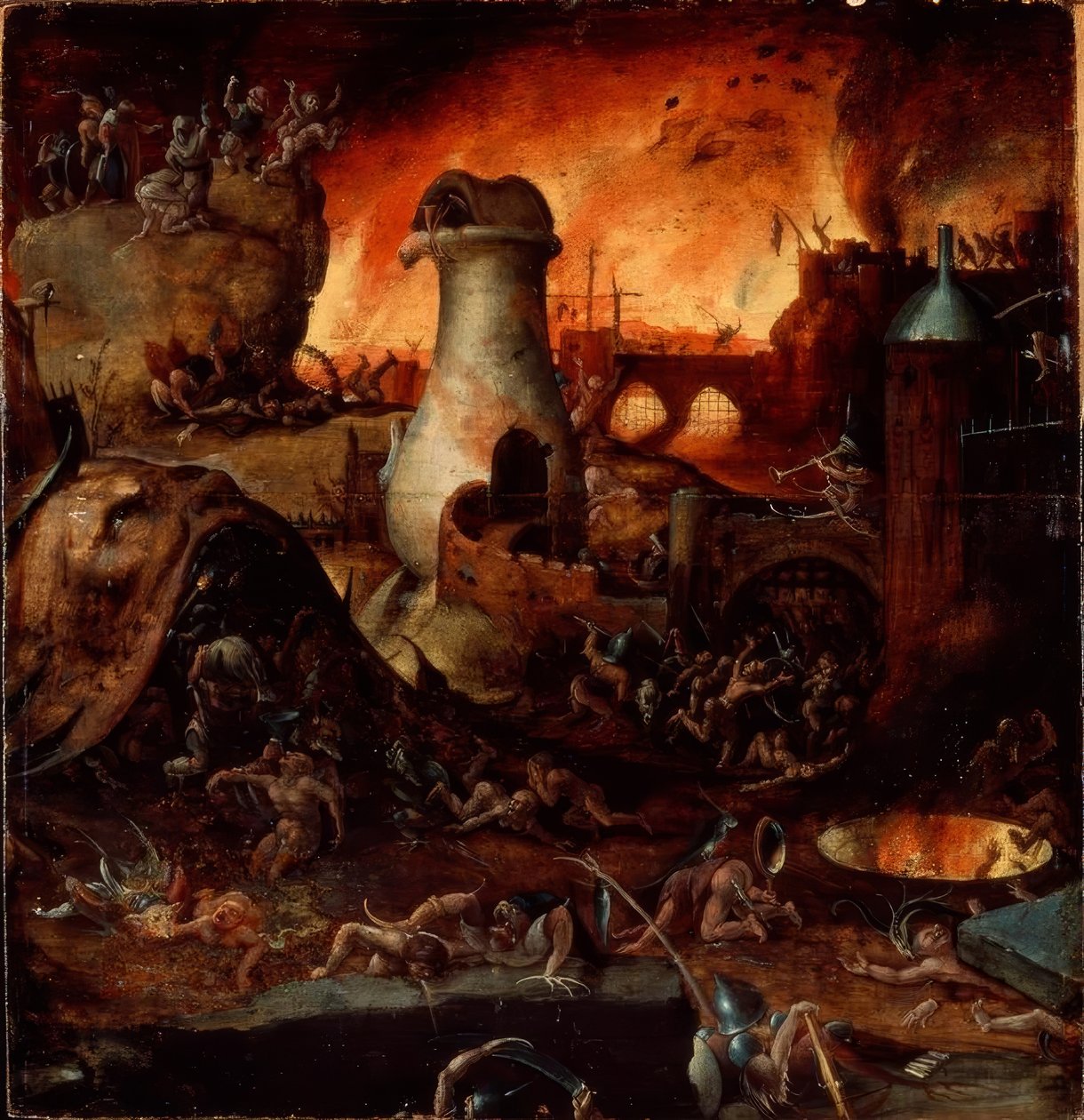
For many years, I have wrestled with hell. By that I mean the doctrine of the final state of the wicked.
There are a spectrum of views, of course, on this subject, but in my view it comes down to two main views among evangelicals. A third view, that ultimately everyone will be saved (known as "universalism") is not supported by more than a tiny minority of those claiming to be evangelical. That leaves two views among evangelicals.
First, there is what is known as the traditional view that the final state of the non-saved is eternal conscious torment and punishment in hell. This view is almost inconceivable for the human mind to comprehend. For a person to experience punishment and, in some sense, pain, for all eternity is an idea so horrific that I think few of us want to even contemplate it. The exact details are sketchy at best biblically - darkness, fire, pain, torment, certainly much less detailed than the vivid medieval depictions of the likes of Dante in writing and Bosch in art.
Nevertheless, it is the most common view held by Reformed and evangelical Christians and there are a number of strong biblical arguments in its favour. It is also the view taught in the Reformed confessions.
Several verses are difficult to reconcile with the idea that the punishment in hell is only temporary in duration.
Matthew 25:46 is one such verse where Jesus himself says: "These [the wicked] shall go away into eternal punishment, but the righteous into eternal life."
Notice he does not say "eternal death" in contrast to eternal life, but "eternal punishment". At least on the face of it, if eternal life is never ending, it would appear that eternal punishment may be never ending also.
A second verse of relevance is Revelation 14:10-11, speaking of those who worship "the beast": "He also will drink the wine of God's wrath, poured full strength into the cup of his anger, and he will be tormented with fire and sulphur in the presence of the holy angels and in the presence of the Lamb. And the smoke of their torment goes up for ever and ever, and they have no rest, day or night, these worshippers of the beast and its image, and whoever receives the mark of its name."
"The smoke of their torment goes up for ever and ever" does not sound like annihilation to me.
A third relevant passage is Revelation 20:10 and 15. "The devil who deceived them was thrown into the lake of fire and sulfur, where the beast and the false prophet are also. They will be tormented day and night forever and ever.... If anyone was not found written in the book of life, he was cast into the lake of fire."
Again, on the face of it, it could be argued that since the lake of fire seems to inflict torment forever, and all the wicked are thrown in there, their suffering would be eternal.
The second view has several different names, but in essence it is that while there is punishment in hell for the wicked, at some point the conscious torment ends and the person in hell ceases to exist. This view is sometimes called "Conditional Immortality" or "Annihilationism". It is sometimes portrayed as if this view teaches that when the wicked die, they immediately cease to exist. There may be some who teach that, but the mainstream of this view is that the wicked are punished in hell for a period of time related to the punishment they deserve for their sins, but that this punishment does not continue forever, but eventually they cease to exist.
In the first view, if a sinner is tormented in hellfire for a million years, he is no nearer the end of his infinite punishment than when he first entered hell. In the second, if the just punishment is punishment for a million years, at the end of this time, the sinner ceases to exist and the active punishment ends, though the sentence of eternal death remains effective forever.
Like many theological disputes, and perhaps more than most, there are good biblical arguments on both sides. Anyone who thinks that the opposite side in this discussion does not have good arguments, simply does not understand the best arguments of the other side.
It is unlikely we will ever be able to be certain about which view is correct this side of eternity. I admit that I cannot really conceive what eternal active punishment looks like. For that matter, I can hardly conceive what everlasting life looks like either. Part of me hopes that annihilationism is true. There may be people I love in hell after all. Eventual non-existence seems more attractive than eternal existence in suffering. As many have pointed out, how can the saints fully rejoice in heaven, knowing their loved ones are writhing forever in the pain of hell?
Yet we must not let our emotions guide our doctrine, but the teaching of the Word of God. And as we have seen, there are certainly verses that point in the direction of eternal conscious punishment.
All I can say is: "Shall not the judge of all the earth do right?" (Genesis 18:25). Whatever God does with the wicked will be the right thing in the end and it will be marvellous in our eyes (Psalm 118:23) because the fate of the wicked whatever else it is, will be according to divine justice.
It's important to recognise that there is not only one way to interpret many texts in Reformed theology. There is a breadth within Reformed theology that leaves enough room for each person to have room to explore their own views while being on the inside of the circle of Reformed theology.
One important example of this that I've had in mind for some time are the Reformed approaches (plural) to the interpretation of a well-known verse such as John 3:16.
We need hardly quote what is surely the most famous verse in the whole Bible, but it reads of course, something like this:
"For God so loved the world, that he gave his only Son, that whoever believes in him should not perish but have eternal life" (John 3:16, ESV).
There are broadly two main Reformed approaches to this verse. My view, explored in some length in my book, The World of John 3:16 could be considered the more restrictive Calvinist view. I interpret the word "world" to mean "sinners from all nations" (i.e. Jews and Gentiles) and that it refers by extension to God's elect from the nations. One of the reasons for taking this view is that the love of God mentioned in this verse seems to me to be the highest type of love in God, his redeeming and electing love that achieves its aim of saving "the world" (see John 3:17). This is the view of many Calvinists—many older Calvinists it is probably fair to say, such as John Owen, Francis Turretin, Samuel Rutherford, John Gill and Arthur W. Pink.
However, I recognise that my interpretation may be incorrect and that there is a second broad interpretation which is every bit as Reformed. The other view interprets "world" as meaning "the human race" or "all of humanity". This view shares with our Arminian brothers and sisters the view that the world is all-inclusive, meaning every human being without exception. However, in this view, the love of God for the world is not the highest type of electing, saving love that God has for his people, but a more general benevolence encompassing everyone, and showing them that he is a God of compassion with what D. A. Carson calls "a salvific stance" towards everyone.
This simply means that his revealed will shows that God has some kind of intent towards the salvation of everyone who hears the gospel on the condition that they would believe. This is the view of many modern Calvinists, but also people in history, arguably John Calvin himself, Thomas Boston and the Marrow Men, and contemporary Calvinists such as R. C. Sproul, John Piper, D. A. Carson, and John MacArthur as far as I can make out.
There are some good arguments for this wider view, though I am not personally convinced by them. That's not to say I deny that other parts of Scripture do indeed teach that God takes no pleasure in the death of the wicked and would have everyone who hears the gospel accept it and be saved in accordance with his revealed or preceptive will, though not in the sense of it being God's decree or we would need to be universalists. It's only that I do believe that John 3:16 is correctly viewed as a text of this type.
Similar arguments could be applied to a number of other texts about which Reformed Christians may take different views. These include what might be called the "Arminian" proof texts such as Matthew 23:37, 1 Timothy 2:4 and 4:10, 1 John 2:2, and 2 Peter 3:9. On all these some Calvinists interpret them in a more restrictive sense, others accept the wider sense, yet deny that they undermine the doctrines of grace taught in Calvinism.
The Reformed Faith is not a monolith. And I believe it is all the richer for it.
Yesterday was the first Sunday of Advent. It marks the beginning of a new Christtian year and the start of the period of Advent leading up to Christmas.
Advent comes from the Latin "adventus" which means "coming" or "arrival". It refers to the period of waiting for the coming or arrival of Jesus Christ, both in terms of his first coming as a baby born in Bethlehem and his second coming in glory at the end of the world. A third sense, which we do not often focus on, is the coming of Christ to live in the hearts of believers through the Holy Spirit.
The long run up to Christmas, much longer in the world of modern commerce than in the church calendar, is one of my favourite seasons of the year.
The great advent hymn, "O come, O come, Emmanuel" can be sung with any of the three senses of the coming of Christ in mind.
I was very interested to learn recently that though the words and music of this great hymn are ancient, they were not joined together until the 19th century, when John Mason Neale translated a medieval Latin text into English in 1851 and then got his friend Thomas Helmore, who used a French medieval sacred tune and reharmonised it to work with Neale's words. For many years there was doubt as to whether had actually composed the tune and only claimed to have "discovered" it. However, in 1966 it was established that it was an ancient French tune. The tune is known as VENI EMMANUEL after the Latin text's opening words.
The resulting text and tune combine to make one of the greatest of advent carols. I could not imagine going through advent without singing this great hymn at least once.
